Troubles with MMT

I read Stephanie Kelton’s The Deficit Myth recently.  Like it or not, Modern Monetary Theory (MMT) is going mainstream. Much like bankruptcies, most economic regime shifts occur very slowly and then all at once, and Kelton’s book will likely be one of the most important for-public-consumption academic books driving economic policy decisions for the next decade plus. Alexandria Ocasio-Cortez, one of the most polarizing politician of our current time has already referred to the theory to be  “absolutely” necessary as “a larger part of our conversation.” 1 The Theory has been repeatedly referenced to by economists, politicians and even Bill Gates.2

One central thesis of The Deficit Myth is that MMT can be used prescriptively rather than simply descriptively. As someone whose day job is pretending to be a real doctor, the difference between the two ideas is pretty clear. Take Koch’s Germ Theory as an example, the theory itself is a description of how diseases happen. The theory proposes that it is the existence of and invasion of pathogens that cause diseases. It supplanted the equally descriptive Miasma Theory, which theorized that diseases came from the intake of rotten smell in the air from rotting matters. Another example closer to my field of work is that dental decays are caused by acid produced by the bacteria S. Mutans. These are descriptions of how things are, and does not offer any prescriptive measures going forward. The prescriptive side of Germ Theory is then: assuming that pathogens are the cause of disease, therefore by eliminating the pathogens, the disease will then disappear. This elimination of pathogen does not necessarily have to be specifically targeted only to the pathogen; a scorch-earth type of elimination is equally efficient. This is clear in dentistry that physical destruction (drilling) and reconstruction (filling) of the tooth eliminates the pathogen and thus the disease, or that injecting bleach will eliminate covid. (Big if true, Donnie.) The Deficit Myth proposes that MMT is not only a descriptive framework of how our monetary system works, but that we can use MMT to make prescriptive policy changes to better the world.

So what does Modern Monetary Theory actually describe? In short, it is a model of our post-Gold Standard and post-Bretton Woods, fiat-based monetary system. The first fundamental idea of Modern Monetary Theory is that there are two different kinds of limits: real and arbitrary, and that we (the US) should learn to “distinguish artificial barriers from legitimate constraints.” 3 What Kelton means is that there are real and artificial limits to what material living standards an economy can support. A crude analogy of mine is that if the reason we cannot make a car go faster than 300 MPH is physics or engineering, then that is a legitimate constraint. But if the reason for that inability is because the legal speed limit is 80mph, then that is an obviously artificial barrier. The difference is obvious. We can easily change the speed limit with a few strokes of a pen, but we cannot break the laws of physics. Same thing with economics, MMT says.

After we accept that there exists a difference between real constraints and artificial barriers, MMT further postulates that in a fiat currency regime, (such as the US, who produces US dollars without any commodity backing) all constraints on noninflationary government spending are artificial. The key word is noninflationary. For MMT the real constraint of a macro-economy is inflation. What this means is that government can (descriptive) and should (prescriptive) print and spend money into economy so it can produce as much goods and services as it realistically can without triggering inflation.

This is the fundamental tenet of descriptive MMT: that inflation is the real limit to the productive capacity of an economy and therefore it is also the limit to the material living standards of a fiat country’s citizens, and all other constraints are artificial. The corollary to this description is that if there is no inflation threat, then government sector can spend by injecting new money into the private sector up to the point where inflation occurs without any adverse consequences. This may sound circular, that if we assume inflation is the only adverse consequence, then there will be no adverse consequence if we assume inflation does not occur. As we will see later, circularities can run the other way very quickly in real life.

So, if we assume away inflationary risks, then any deficit that resides on the federal government’s balance sheet does not matter. Under the MMT framework, fiscal austerity for the sake of budget balance in a fiat regime is silly, and any criticism of noninflationary deficit spending is misguided. Empirically for the last 20 years, inflation has not been a major problem in the US, yet the US has printed trillions of dollars running the dreaded twin budget and trade deficits. None of the stern warnings of the deficit hawks from Ross Perot to Ron Paul came true. Even Wall Street traders were not impervious to deficit hawking. Paul Tudor Jones and Michael Steinhardt have been worrying about the federal debt since the mid 80s, as their interviews with Jack Schwager in the Market Wizards have dated. 4 Yet since America had not experienced major inflations in the last 20 years, there has not been any negative consequence of the huge expansion in government debt from running continuous deficits. Empirically, descriptive MMT has been pretty spot-on in its explanation of the post-Bretton Woods fiat regime. The trouble with MMT is its use as a prescription going forward.

If we revisit the difference between descriptive and prescriptive, we can see that the prescriptive tend to be the logical consequent of the descriptive, if and only if we assume no major changes (stationarity) to the described process going forward. Such stationarity assumption has worked remarkably well in medicine because the process of disease pathogenesis never biologically changed since the discovery of Germ Theory. Yes, bugs mutate and develop resistance after repeated exposure to the same therapeutic agent, but the pathophysiology of a Staph Aureus infection has remained the same. Only because the pathogenesis is the same, we can use the descriptive knowledge to prescribe medical interventions for future staph infections.  Had the world been so cruel such that once the pathophysiology of a disease is known, the pathogen alters its mode of infection, medicine would be much less successful than it currently is.4

Human are not bacteria. When it comes to human affairs, an assumption of stationarity is not valid. George Soros has been writing about reflexivity and fallibility since Alchemy of Finance in the 80s. In his 2014 paper Fallibility, Reflexivity, and the Human Uncertainty Principle, Soros explicates the definitions. Fallibility, Soros writes, occurs when “the participants’ views of the world never perfectly correspond to the actual state of affairs.”5 In other words, one’s description of how the world works often isn’t how it actually works. Soros then defines reflexivity to “apply exclusively to situations that have thinking participants” with abilities to both understand (describe) and manipulate (prescribe) the situation that they are involved in. Economics is obvious one of those situations. An attempt to prescribe often alters what was described. Under fallible conditions, the relationship between cause and effect is always imperfectly understood. Upon reflexivity, cause and effect becomes circular and feed upon each other, which deprives the observer of a true independent variable. According to Soros, fallibility and reflexivity is inherent in the human condition, and we have to wrestle both with whether or not our explanations for the past is correct and if such explanations can be depended on going forward.

Fallibility of MMT

            One of the fallibility concerns with MMT is that even if we assume the Theory is descriptively correct, there are still some parts of the Theory that has not been ironed out. MMT says that government does not have to tax first in order to spend, that is technically true. But reality is, neither do you or I. We all have credit cards that allows us to spend before actually paying. This is the definition of credit. Government can “print money” to pay for Boeing fighter jets much like how we can drive a brand new SUV off the lot with little more than a minimal down payment. But make no mistake, both examples of spending is funded by credit, and what determines creditworthiness is real productive capacity. For an individual, creditworthiness depends the ability to take ownership of the product of one’s productive capacity. This is a highbrow way of saying you only get credit if you have something valuable, or have an ability to generate value. Therefore, if an individual does not have and cannot produce anything of value, or cannot claim ownership of the generated value (for example, under a 100% tax environment,) credit cannot exist for the individual. The creditworthiness of a government on the other hand resides in its ability to tax its citizens’ real productivity, which is determined by the nation’s nature resources, labor pool, capital supply, and technology. This is why developed market (DM) countries with more productive labor, deeper capital base, and better technology can borrow at far better terms than Emerging Markets (EM) countries, because the tax base is much larger in DM countries.

Kelton further argues that the massive size and deep liquidity of the US Treasury Bond market demonstrates that there are excess demand for US T-Bonds, and therefore the US government can soak up the excess bid and sell more T-Bonds and be able to deficit spend much more than we currently are. But I would suggest the excess demand for T-Bond is not an intrinsic property of US T-bonds, but it is rather the excellent creditworthiness of the US that allows the demand for US T-Bond to outstrip supply. The world demands US T-Bonds because the US is viewed to be creditworthy, and the US is creditworthy because of Uncle Sam’s perceived ability to tax the real productivity of the world’s biggest economy. This is what everyone means when they say US T-Bonds are the “safety trade.” Therefore while it is correct the government doesn’t need to actually tax in order to spend, it is not true that government does not rely on taxpayers as Kelton claims, or that “taxpayers do not fund anything” as MMT economist Bill Mitchell has written. The taxpayers’ productivity is the ultimate source of their government’s perceived creditworthiness, and this real productivity by the taxpayers is the source of the government’s spending. 6

A second point to the fallibility of MMT involves Kelton’s prescriptions for many of today’s societal ills. We have already seen that when the lens switches from descriptive to prescriptive, we not only have to be certain that our models does well explaining the complexities of past, but have confidence our model will perform in the future. This is no easy task. As Soros says, when “confronted by a reality of extreme complexity, we resort to various methods of simplification.” MMT is no exception for this simplification. MMT compresses the complexities and textures of societal ills to a singular cause: a lack of (public) investment. There is a common meme that MMT is a political stance masquerading as an economic theory. When it comes to the prescriptive side, the meme is a not completely untrue. For example, Kelton states that US has what she calls a “good jobs deficit” in that “the flow (of money) grant good pay and great benefits to a small portion of fortunate Americans and meager pay and little-to-no benefits to a great many more.” In other words, Kelton has found the increasing wealth and income inequality to be unpalatable. She argues that MMT teaches “any currency-issuing government has the power to eliminate domestic unemployment by simply offering to hire the unemployed,” and adds that MMT recommends “these jobs pay a living wage and that the work itself should serve a useful public purpose.” She contends that this nondiscretionary government spending would act as an automatic stabilizer for the business cycle. During economic downturns, the number of “good-paying” federal jobs would automatically increase due to private sector job cuts and therefore increase government spending to offset the reduced private spending from the downturn. “Universal job guarantee is the MMT solution to our chronic jobs deficit.” Kelton exclaims.

This solution is of course extremely unpolished. First we already discussed that the ability to tax the real productivity of a country is the fundamental source of government spending. Taken to an extreme, if a country cannot produce anything of value, then it matter little if everyone is in a well paid position —all goods/services would have to be imported and the domestic currency of the country would not be accepted for anything of value. Second, if the federal government become the undisputed “employer of last resort” offering guaranteed “good” wage, then what is the mechanism to deter poor job performance? To put crudely, if one cannot be fired, what incentive will there be to at least perform the duties to a minimum standard? What would this guarantee do to the cost of employment in the private sector? What about the business that cannot accommodate such federal wages? Should such businesses be subsidized? What about the potential retirees who want to return to the workforce to collect a paycheck? What about ex-criminals? What changes need to be made for workplace safety to accommodate this new group inside the labor force? How will this affect employment law? Very quickly we can see how the complexity of this one single policy can spill over into every facet of employment. Universal job guarantee seems destined to reenact the old Soviet saying of “we pretend to work and they pretend to pay us.”

Kelton subsequently argues that it is actually not sufficient to have an amped up nondiscretionary stabilizer, but we should increase our discretionary spending as well. She presents that the country has a healthcare deficit where the costs are high and the outcomes are poor. Her solution is for the federal government to spend into improving healthcare infrastructures by building more clinics, educating more doctors, and that in turn will increase the capacity of the economy, which should relieve any inflationary concerns that this spending will create. Kelton has the same prescription for many other what she calls “real deficits” of the country such as “education deficit”—more spending into K-12 and universities; “infrastructure deficit,”—more spending to build roads and bridges; and pretty quickly we end up in the leftist deep waters of “climate deficit” – more spending to fund the Green New Deal; and “democracy deficit.” – more spending into ??? Of course, just like the trouble with Universal Job Guarantee, the complexity of each solution and our fallibility to understand them presents significant concerns, and this presents significant risk for the well-intended prescriptions of MMT.

The final point of MMT’s fallibility has to do with inflation. As previously stated, MMT’s main insights are 1. There is a difference between a real and artificial constraint. And 2. The only real constraint of government spending is inflation and everything else is artificial. It is obvious that inflation is the most important variable to track and forecast in the MMT framework, so one must surprised to learn that MMT does not have a coherent model to forecast inflation. For example, The Deficit Myth never actually explores the most important question under Kelton’s MMT framework: if every prescription she writes actually gets filled, how would that affect inflation? Also, what do we once we are at the “real constraint?” Do we destroy those clinics in the name of true austerity? Do we shut down the newly built schools? Do we stop digging a tunnel midway? What about the Good Job Guarantee? What would happen if such vast increase in the of number federal jobs triggers inflation? Would the guarantee just go away? How do we tell those that had the guaranteed federal jobs? That their guarantee wasn’t really a guarantee? Would they have unemployment benefits, or would that be inflationary too? The complexity risk is extreme, and MMT does not offer any answers, Kelton simply states that these policies would be monitored by the Congressional Budget Office (CBO) to assess its impact on inflation. The CBO currently assess policies by projecting their effects on the deficit, which is arguably an easier task than projecting inflation.

Kelton also suggests that these policies better the society and therefore its real productive capacity, which should tame any inflationary pressure coming from the federal deficit spending. Therefore she recommends during a New York Times interview that government spending should thought of as “self-financing,” as the government “can pay its bills by sending new money into the economy.” 7 Yet the only way government spending is “self financing” in real terms is if these government projects generated more value than the initial investment, otherwise the self-financing idea is tautologically false. This is a very high bar for the government sector without a profit motive. Nevertheless, we are not talking about how inflation happens under MMT; we are doing a scenario analysis on the complexities of the consequences if inflation occurs under an MMT regime. MMT has no solution aside from denying the assumption that inflation can occur, because it cannot model inflation. If we cannot model inflation correctly then we cannot correctly forecast the inflationary impact of policy prescriptions. Without an ability to accurately forecast the most important variable in the MMT framework, any prescription based off the MMT framework truly is just politics masquerading as economics, and is infinitely complex and risky.

MMT & Reflexivity

            Reflexivity is rooted in the philosophical idea of self-reference. Self-reference describes an entity’s feedback loop from and onto the entity itself. Self-referential statements may seem inconsequentially harmless or even whimsical, but is actually seriously explored in philosophy, computer science, linguistics, and many others important fields. The classical example, as Soros used, is “This sentence is false.” (Think about this sentence. If true, then it’s false. If it’s false, then it is true. Ad infinitum.) Reflexivity is a broader version of such self-referring feedback loops. Reflexivity occurs in events where entity A exerts an effect onto entity B, which leads to entity B to exert an effect back onto entity A, and the cycle repeats. Thus, as mentioned previously, the cause and effect becomes circular so the independent and dependent variable amalgamate together and become indistinguishable. Soro’s big idea was that financial market is mired in reflexivity, and that this reflexivity and fallibility create a self-referencing loop unto themselves and makes all decision making inherently uncertain, he calls this The Human Uncertainty Principle.

The reflexivity problem of inflation isn’t new. Economists and financiers have long separated inflation and inflation-expectation and understood that there is at minimum some self-fulfilling loop between the two variables. In other words, we have long understood that if we expect that general price level will increase tomorrow, we will push forward some future purchases to today, which triggers the inflation that we expected. We however do not know what the exact relationship is. Economists have dedicated their lives trying to explain inflation to minimal success. Stephanie Kelton herself says on the Macrovoices Podcast that inflation “is a dynamic process,” “a complex phenomenon” and that “there isn’t economist on Earth who can write down for you a model of inflation that will apply in all times across, space and time, nobody can do it.” This uncertainty with regards to measurement of inflation is the fallibility that gives reflexivity its starting point.

            MMT’s reflexivity loop is as follows. Given that

  1. MMT prescribes to enable government to deficit spend up to the point of inflation (the real constraint)
  2. Expectation of enacting prescription under MMT may affect some people’s expectation of inflation because not everyone is a believer of MMT.
  3. Those changes in expectation of inflation will affect actual inflation.
  4. This puts us closer to the real constraint of inflation on point #1.

As we can see, beyond the inability to model inflation, just the presence of a large enough group of people who expect inflation to occur when governmental deficit spending is increased, will cause actual inflation. Thus even if we give MMT economists perfect ability to model inflation under MMT, the fact that there are nonbelievers of MMT still makes MMT fallible, and reflexivity can cause a self-referencing loop between inflation and inflation expectation. Again, MMT cannot model the single more important variable in its own model, and even if it could, due to reflexivity it still couldn’t.

The second flaw of MMT with regards to reflexivity resides in the fact that MMT creates a false dichotomy of a nominal ability and the real ability to pay back debt, when in reality the relationship of the two is reflexive. To understand this fundamental error, we need to ask why do we ever bother paying back any debt.

            The late David Graeber wrote in Debt: The First 5000 Years that violence is the backstop to debt, and that is what enforces payment.8. Graeber goes as far as saying, “Any system that reduces the world to numbers can only be held in place by weapons, whether these are swords and clubs, or nowadays ‘smart bombs’ from unmanned drones.” What he is saying is that he who has the gun makes the rules. Graeber identifies correctly that a government is much like the Mafia and its monopoly on violence gives it the ability to settle any debt nominally. I thought this was a rather dark view of human enterprise, but I do think Graeber has a point here. Ultimately, what MMT is suggesting is that governments, and more specifically, The Federal Government of The United States of America, holds both the power to enforce debt repayment from almost any counterparty, including other soverign states, and can pardon any obligations it owes by fulfilling the obligation in meaningless ledger entries.

            However, that view is ultimately assuming that debt is a single-shot game. In the real world, debt is a iterative game. I would argue that the practical reason to pay back your debt is to allow you the creditworthiness to take on more debt in the future. We have already explored above that creditworthiness is no different for governments. When MMT says that a fiat currency issuer will always be able to payback any debt denominated in its currency and thus never be insolvent, it is only the partial truth. What should be included is that this limitless repayment is only in nominal terms. A fiat currency issuing government can create limitless nominal financial assets – cash or bonds to offset any nominal debt obligations. However it does not mean that a fiat currency issuer can settle any real debts indefinitely. MMT has the incorrect idea that governments can offset real obligation with nominal repayments unless there is inflation, when reality is that if government offsets real obligation with nominal payments, it creates inflation. The reason is inflation is created when the storage of value function of the money deteriorates, and that demand for real goods exceeds demand for money. When settling real obligations with nominal payments, future demand for such nominal financial assets will drop because the creditors are not getting the real return they expected, and so their required nominal return is pushed higher in order to be compensated appropriately. This increased future required interest rate makes obtaining future funding more difficult for the debtor. The reflexive loop here is that using nominal payments to offset real obligations will increase the future nominal costs to offset future real obligations. This is inflation: ever increasing monetary costs to exchange for the same real goods/services. In essence, private businesses without a money printer go insolvent in nominal terms when demand for their financial assets drops too much, while governments with a money printer experience inflation when demand for their financial assets drops, and they go insolvent in real terms.

Fundamental Error of MMT: Human Uncertainty and Risk
            We are at the last point of this overly long post on MMT. We’ve so far explored 5 mistakes of MMT. First, taxpayers do fund government spending. Second, Kelton’s prescription has innumerable unintended consequences. Third and fourth, MMT does not have a model of inflation that it desperately requires, and due to inflation expectation’s reflexive loop with inflation, it never can model inflation endogenously. Lastly, MMT’s prescription to offset real obligations with nominal payments will cause the inflation that disallows them to prescribe further. What this translates to is

  • We don’t know if the MMT model is descriptively correct
  • We don’t know the unintended side effects of MMT’s prescriptions.
  • We don’t know how to measure the risks of those prescriptions.
  • We do know that there are reflexive loops that amplify those risks.

            My final point is fairly simple. As Soros said, fallibility and reflexivity makes all human affairs inherently uncertain. In an uncertain world, risk mitigation is far more paramount than being correct. When the government misunderstands deficits to be intrinsically harmful, and let’s be clear, it is a misunderstanding because deficits per se are not harmful; what is actually happening is that deficits are being using a imperfect heuristic to gauge the real danger: inflation and disintegration of the monetary and social system.

            An old tale has it that due to poor ventilation technology, early coalminers were extremely vulnerable to dangerous concentrations of noxious gas buildup in the mines. So these early coalminers carried canaries into coalmines with them. The reason is that canaries are far more sensitive to these noxious gas buildups than the coalminers were. When the concentration reached levels sufficient to harm the canaries, the coalmines were evacuated. These little bird were the heuristic to an invisible risk, much like using a easily measurable figure in deficits as an early warning to inflation. MMT’s proposition is that we get rid of the canary in the coalmine, and butt ourselves right up to the uncertain limits of the inflation. Just like the dreaded carbon gases in those old coalmines, this inflation limit is invisible to our currently available tools, and just like the gases were deadly to the coalminers, the risk of inflation is existential to our society. Kelton’s suggestion that every government policy is to be assessed on its probability of triggering inflation is dangerous because she herself realizes inflation is currently almost impossible to model. Yes, the deficit is not an accurate gauge of inflationary pressure, and no, the current system is imperfect, and has caused much undesirable collateral damages. But putting a veneer of deficit hawking has served its purpose well enough as a heuristic, that until a demonstrably more accurate model of inflation can be constructed, it just seems unwise to scrap the canaries for a theory that has yet to resolve all of the problems mentioned above.

Reference

  1. https://www.businessinsider.com/alexandria-ocasio-cortez-ommt-modern-monetary-theory-how-pay-for-policies-2019-1
  2. https://www.theverge.com/2019/2/12/18220756/bill-gates-tax-rate-70-percent-marginal-modern-monetary-theory
  3. Kelton, Stephanie. The Deficit Myth: Modern Monetary Theory and the Birth of the People’s Economy. Illustrated, PublicAffairs, 2020.
  4. Schwager, Jack. Market Wizards, Updated: Interviews with Top Traders. 1st ed., Wiley, 2012.
  5. https://www.georgesoros.com/2014/01/13/fallibility-reflexivity-and-the-human-uncertainty-principle-2/
  6. http://bilbo.economicoutlook.net/blog/?p=9281
  7. https://www.nytimes.com/2017/10/05/opinion/deficit-tax-cuts-trump.html
  8. Graeber, David. Debt : The First 5,000 Years. Brooklyn, New York`, Melville House, 2014.

How not to sell a car

Me: “I wonder how this guy feels when he looks at himself in the mirror.”

Friend: “Like a goddamn BMW salesman.”

The stereotype of a sleazy car salesman has no worries that it might lose its relevance in the lexicon any time soon. There are still plenty of these people around, if you’re not careful, you could get in for a bad time next time you enter a car dealership.

The lease end is rapidly approaching on my car. Since I would soon be required to return this leased car, I figured it would be a good time to start looking for some deals now, before the clock runs out. I have some thoughts on leasing cars, and why, having leased once, I would probably never lease again. More on that later.

So a few weeks ago, after a few calls and voicemail from a certain BMW dealership in regards to lease-end, I decided to email them back about getting a pre-lease-end inspection on the car. The inspection serves to give you an idea on how much “excessive” wear and tear on the car you have put on the car, and give you an opportunity to have the excessive wear and tear fixed before the turn-in date.

Here is what I wrote.

Yes I am aware of the lease end coming up and I am definitely interested in going over some lease end options.

The salesman, let’s call him George, responded promptly to the email. In his email, George asked if I had some time the very day to go over some deals he has been putting together for me. Presuming a phone conversation, I answered that I can probably have a phone call at 1:30.

A few minutes after the email was sent, George emailed back “see you at 1:30.” It turns out he wanted me to go into the dealership and take a look at the options he has available for me.

No, I called George at 1:30, I can’t actually be at the dealership at 1:30 because I am at work. But I do have time the very next day, since it’s my day off. Perhaps 8:30 in the morning will work.

“No,” George flatly replied, “we don’t usually do business that early in the morning.”

Shouldn’t somebody that want your business jump at an offer for an appointment, or at least offer a counter proposal if the timing is truly inconvenient? Also, I checked online later, and the dealership is open for business each day at 8AM.

Feeling a bit slighted, I asked George to email me some of the special offers he told me that he has been working on, I will review them and call him back to schedule at a more convenient time.

A vapid scan of a previously letter containing the offer was emailed to me as follows. The missing half of an inch on the right margin was a nice touch.

Screen Shot 2019-07-17 at 8.27.22 PM.jpg

The offer was for a 2019 model year version of essentially the exact same car I currently lease. This is not a strong offer and it is not of interest to me. The 2020 model year saw a significant facelift and upgrade, so even if I wanted to upgrade into the same vehicle, I would want to upgrade into the 2020 version. In response, I sent George the following message.

I am considering a ______ at the end of this lease. If you can send me some of the offers available, that would be great.

No rapid replies this time. In fact, no replies at all. The silence wasn’t exactly deafening, but it was strange.

A week later, I emailed George a direct one liner.

Hi George, Was wondering did you not find any good offers for a _____? Let me know. 

This technique was adapted from former FBI hostage negotiator Chris Voss’s brilliant book Never Split the Difference. Almost without fail, something along the lines of “have you given up on X” seems to always bring a stale conversation back to life.

George quickly replied.

I would love to know what BMW has to offer in 4 months (my lease end date), but unfortunately I don’t have that information.

The offer was on any vehicles, obviously the lease term and rebates are different from model to model! I will help you in achieving what you like in terms of vehicle and lease structure, however…. I need you here, select a vehicle, I will inspect your leased vehicle and we will make sure you’re comfortable with your new vehicle.

I Just had a cancellation for my 1:00 PM appointment, can you come in this afternoon?

At least he offered the pre-lease-end inspection this time. I told George that I still cannot come in on short notice, but perhaps we should schedule an appointment time on my day off that works for both of us. I offered 9AM, since he doesn’t do business at 8:30.

George countered with a single available appointment time: 11:30 AM.

Funny, I didn’t realize we were already negotiating.

I called George around 10 on my day off, and told him that I was going to show up a little bit earlier than 11:30. Magically, his packed schedule is suddenly open, and I was “free to come as early as I want.”

At the dealership, after checking in the car for the inspection, George came out to meet me. He was a thin short man, with thick brown eye brows and graying hair.

Famed short seller Marc Cohodes has a heuristic on finding fraudulent companies. He firmly believes that CEOs who wears wigs is heavily correlated with fraudulent corporate behavior.

I have one of those weird heuristics of my own. It’s not wigs, but rather sharply pressed shiny dress shirts without an accompanying tie or blazer. The type of shirt you see on drunk bros with the sleeves rolled up at a Las Vegas night club. The type of shirt you see on sale in a glossy monotone for $29.99 at Express Men. The type of shirt George was wearing (without a tie.)

My obscure logic goes as follows. If you work in a place that requires business attire, such shirts will almost always come with a tie attached, if not a full suit. But if you work in a place that asks for business casual, then the shiny shirt is just peacocking, and honest people don’t peacock.

So I struck a conversation with George. First thing I said was that sure, I would love to  look at some available new or slightly used vehicles, but I’m done leasing. My issue with exceeding the mileage requirement on the current lease, the headaches I have at lease-end, and my plan to keep this upcoming car for a little longer past the warranty date meant that I simply do not want to pay the first 3 year’s depreciations on ever rotating new vehicles.

Greg’s eyes scrunched for half a second before quickly flattening back to neutral. “Why?” he asked, with a slightly inquisitive but mostly dismissive tone.

“Well I drive a lot and with leases I don’t want to pay extra fees at…”

“No, no That should be the reason you lease, my friend.”

Apparently I’ve already made a friend.

George started talking, makes unbelievably verbose and intricately bombastic arguments. Some of the arguments he made were legitimate. Lease does reduce the tax hit, you don’t pay sales tax on the entire purchase price of the vehicle on a lease, but only on the lease payments. However, we are in a state without sales tax, nullifying this advantage.

Other arguments were not. Lease does not magically offer fewer repair headaches, at least not for free. There’s no free lunch, so your lease payment includes the cost of the warranty. The only reason leases are viewed to have free repair costs is because you’re continuously paying for a new car. A particular gem from George is when he said “when you lease, BMW eats the depreciation and not you!”

Leases in all its convolution, are priced by a very simple formula:

(Price at beginning of lease – Price at end of lease) + Fees+ Interest+ taxes and divided by the number of months

Taxes we can’t control, but the other 5 factors are adjustable.

Dealers call Price at Beginning the Gross Capitalized Cost. Higher initial Price, Higher lease cost.

The Price at End is called Residual Value (calculated by a residual percentage x MSRP.)  Higher Residual value, lower lease cost.

(Price Beginning – Price End) = Depreciation of the car, the major cost in a lease. Higher Depreciation, higher lease cost.

The fees are called fees and they are always negotiable.

Interest rate is called Money Factor in a lease. Pro Tip: just multiply the money factor by 2400 to get a percentage rate to de-bullshit.

Lastly the more months in the lease, all else being equal, means lower cost per month. (A $10,000 10 month lease is $1000 a month. A $10,000 100 month lease is $100 a month. It’s not rocket science here.)

In the end, the simple math is that depreciation is higher in the initial 3 years of a car than subsequent years. In the long run over multiple leases, you will almost always pay more in depreciation switching from new cars to new cars, than if you stick with the old car for a few more years. Finance stripped of the bullshit is really not that complicated.

Curious what else George would say, I told him I’ll keep an open mind on the lease option. (I wasn’t.)

George decided to finally do some inventory search on his two screen setup. Sifting through pages quickly, scribbling a few numbers down, find a car and proclaims “this is your car!”

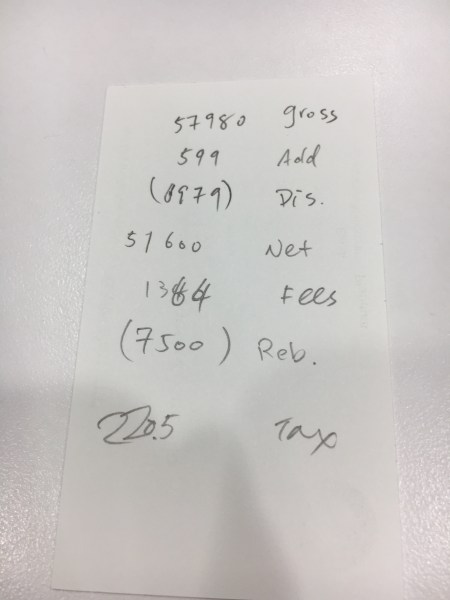
The car looked good on the screen. It’s shiny and sleek. It has 4900 miles and has been a service loaner. George proceeded to explain how great the car is. It has been a service loaner, he says, and it is so close to the 4800 mileage limit where he is no longer able to lease. “I can get you $7500 of rebates on top of the high discount!” George proudly announces as he turn the screen towards me. Initial price: $49,999 after discounts, with a $7500 in manufacturer’s rebate, plus $599 in added accessories.

George started inputting the numbers into his spreadsheet program. The way the car price is inputted into the program is MSRP – offered discount = initial selling price. In his spreadsheet, he would input the MSRP and the discounts, and the program would calculate the initial price ($49,999).

George puts in the MSRP as labeled $57,980 and types in the discount and add ons.

“57,980 MSRP”

“6,979 Discount”

This Geroge’s last name must be Soros, because he just made a cool $1,002 with a few taps on a keyboard. (57980 -6979 =51,001. this number is not shown anywhere on the spreadsheet)

A few more taps laters, with George completely silent as he slides past the money factor (high) and the fees (very high), while making sure I was reminded of his generous rebate offer, a monthly payment number came out.

“Now this number is for a 30 month lease, because I want you to be covered for the free maintenance offered for 3 years, and with this car being a service loaner, the maintenance was already started. So if you lease the full 36 months you may be on the hook for a maintenance.” George said, smirking, “I’m trying to minimize your cost here.”

What a fucking guy.

The crazy thing is that George did not change any of the other factors.By ending the lease 6 months early, the residual value (price at return) should be higher. In essence, if I rent something for 30 months, I should pay less than if I rent for 36 months. George kept the residual value exactly the same, which meant the total amount paid was the same. George’s magnanimous offer is to keep the total amount paid the same, but to shorten the lease by 6 months in order to avoid the charges of one oil change. Again, this guy’s last name is definitely Soros, because he just made an additional 20%.

“Hey George, can you print this price sheet out for me so I can run it by the accountant?” I asked.

“Absolutely not, this deal is for your eyes only” He said, slyly pointing to the $550 figure on his spread sheet. “My boss would kill me if he sees this offer.”

Just to see what he would do, I grabbed a pen, took a business card and started copying the numbers off the screen.

“You don’t have to do that!” George exclaimed with noticeable disagreement. But ultimately he did not move the screen or try to close the spreadsheet.

“No, I do. I need to run the numbers by my accountant.” I replied.

Your accountant don’t pay your bills man. This is a great deal.”

“I understand this is a great deal George, but I don’t make the decision until I talk to somebody. I’m terrible at math George.” I shrugged at George.

Muthafucka you don’t pay my bills either.

Sensing that the great deal is probably busted, George finally went silent.

IMG_9483

At this point George has tried to strong arm the time of meeting, lied about his availability, ignored my requests to not lease, manipulated the sale price, maximized on the interest and fee charges, shortened the lease term, and refused to print out the numbers, all the while repeated on how great of a deal this is. What a fucking guy.

There is a classic exchange in The Big Short where Vinnie (the buyer of esoteric credit default swaps offered by DeutscheBank) grills Jared (DeutscheBank seller) by asking “How are you fucking us?”

decd27d2-6f29-448d-96d2-b90dce71f949_text_hi.gif

This level of due diligence was hardly necessary here. This guy has so openly offered such an unbelievably shitty deal. He is right that this is the deal of the century, for the dealer.

I asked if I can have the inspection report. George replied that I shouldn’t worry about the inspection, and that if I sign the lease, he can have the lease end charge wiped clean. I thanked him for his generosity, however, I maintained that I would still need the report.

Noticeably dejected, George fumbled an iPad from his desk and pulled up the lease end report. He had it this whole time. I asked him to have the service center print it out for me.

If George is going to waste my time with these type of unbelievable sales tactics, I decided that I was going to waste his. I asked if I could see the car, knowing that he can’t possibly say no.

We got up and started pacing slowly towards the garage. When we got to the car, I  pressed every button there is to press and asked every question there is to ask on what was essentially the same car I currently lease. George was visibly annoyed and his answers were clearly getting short. He knew I was now just wasting his time, but he had no way out of it. He was getting squeezed.

When we got back, the report was on his desk. I took the lease-end report and said I will think about his great offer.

George didn’t walk me out.

The final kicker was, there was actually no way to end the lease early. George was simply going to add the remaining lease payments on the current car into the price of the new lease, allowing me to pay the lease payments for 2 cars while having just 1.

Again, what a fucking guy.

The worst trade I’ve never made

How to call it right and get it wrong.

Smart people call it right and win. Dumb people call it wrong and lose. It takes a special kind of idiot to call it right and still lose. On February 5, 2018, I was that special idiot.

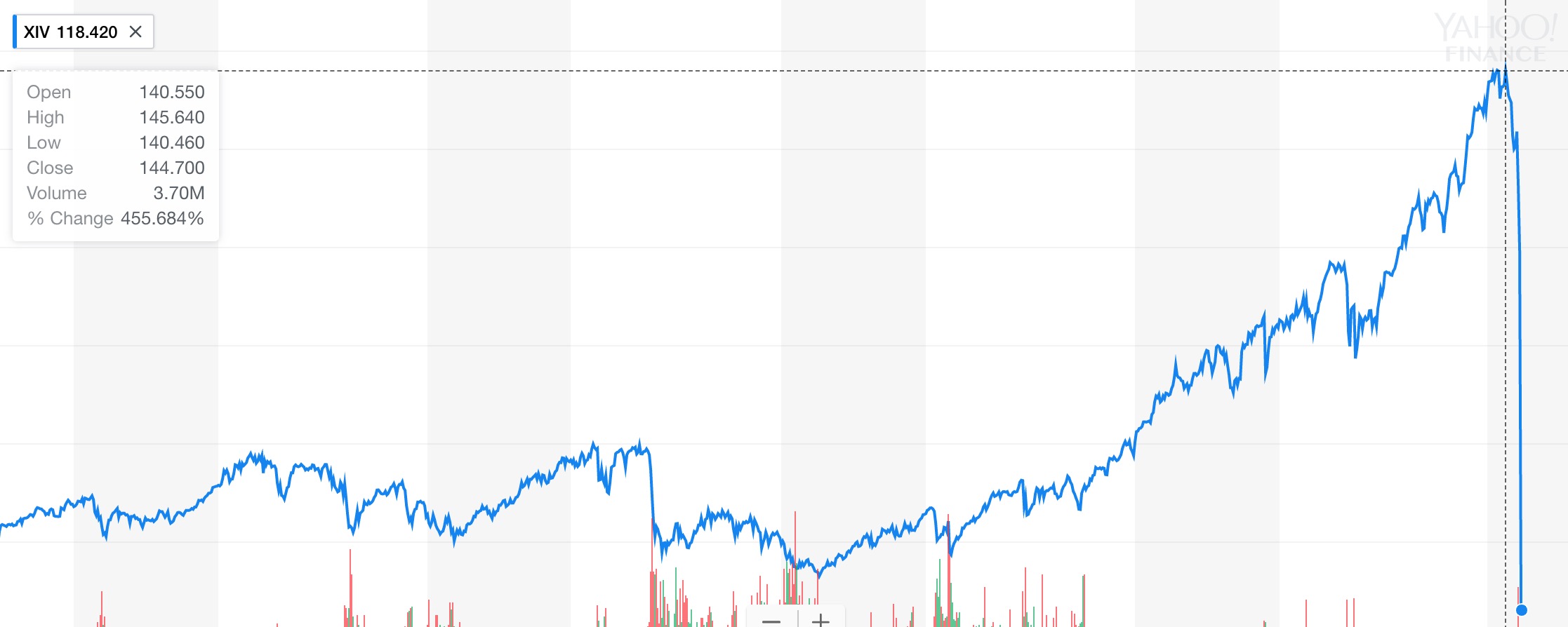
On that eventful day, the VIX index surged 118%. The near-months futures went deep into backwardation, causing billions of dollars of damages to short volatility traders. The index closed around 37, something unthinkable just a couple of weeks earlier when it hovered around 9 for much of January, and averaged about 11 for all of 2017. It was so unthinkable, that it literally blew up Credit Suisse’s XIV Exchange-Traded-Notes after the closing bell, as margin calls on the futures contracts steamrolled the equities in the ETN.

Screen Shot 2018-02-06 at 7.12.05 PM.jpg
The XIV blow-up.

The VIX index, created by the Chicago Board of Options Exchange in the 1990’s, is often called the “fear gauge” of Wall Street. To understand what the index signifies, we need a little bit of background information.

Most people know about the stock market, bond market, real estate market, and nowadays most people even know about the cryptocurrency market. Yet, underlying all of these markets is an identical intrinsic property, volatility.

What is volatility? It’s an easy concept to understand, but it is difficult to put into words. When applied to financial markets, some have described it to be a measurement of the “speed of the market” (Natenberg), and others have described it to be a statistical “measure by which a security is expected to fluctuate in a given period” (McMillan.)

In the most concise way I can explain without too much distortion, volatility is the likelihood and the size of deviations from the average. It is a measure of uncertainty. I have written in the essay on bitcoin that the volatility is what makes bitcoin unfit to be a currency. The underlying idea was that bitcoin prices can undergo sizable changes very quickly, and therefore you could not use it as money for anything.

The key question is how do we measure this vague “measure of randomness?” Volatility can be measured two ways, backward looking and forward looking. Realized Volatility is a measurement of volatility in the past, and is fairly easy to calculate. It is simply the standard deviation of the changes away from the average prices over a certain period of time. Future Volatility is more difficult to conceptualize. Future volatility is forward-looking, and contains all the inherent uncertainties of the unknowable future. Thus we can never actually calculate it with much certainty, and all future volatilities are estimates. Soon option traders started calling their estimates for future volatility the Implied Volatility (IV). So while IV may have the same units as realized volatility, it is not derived the same way. Realized volatility is a concrete calculation from past data, implied volatility is simply an educated guess of what the future volatility is.

Most traders estimate implied volatility by calculating the realized volatility of a certain period in the past as a baseline (usually with a n-day moving average,) and apply a rough mental adjustment. An example would be if the S&P500 Index has a realized volatility of ~12% over the last year, and a certain piece of bad news suddenly breaks out. The actual effect of the news is not known until retrospect, but we would expect prices to move more than it did during the relatively calm previous 12 months. So a mental adjustment is applied to the 12% realized volatility, and the implied volatility would be perhaps 25~30%.

The actual construction of and the mathematics behind the VIX index are complicated (has to do with 2 near-months futures and variance swaps) and irrelevant to this essay, but goal of the VIX is to estimate the future volatility of the S&P 500 over the next 30 day. In other words, the VIX index is the implied volatility for the S&P 500 for the next 30 days. The reason it is called the “fear index” is because it is often the crashes and not the gains that lead the biggest and fastest price changes in the market, i.e. the biggest increase in market volatility. It is always quicker to roll down the hill than it is to climb up, and the market is no different. (This is something we will revisit soon in extensive verbiage.)

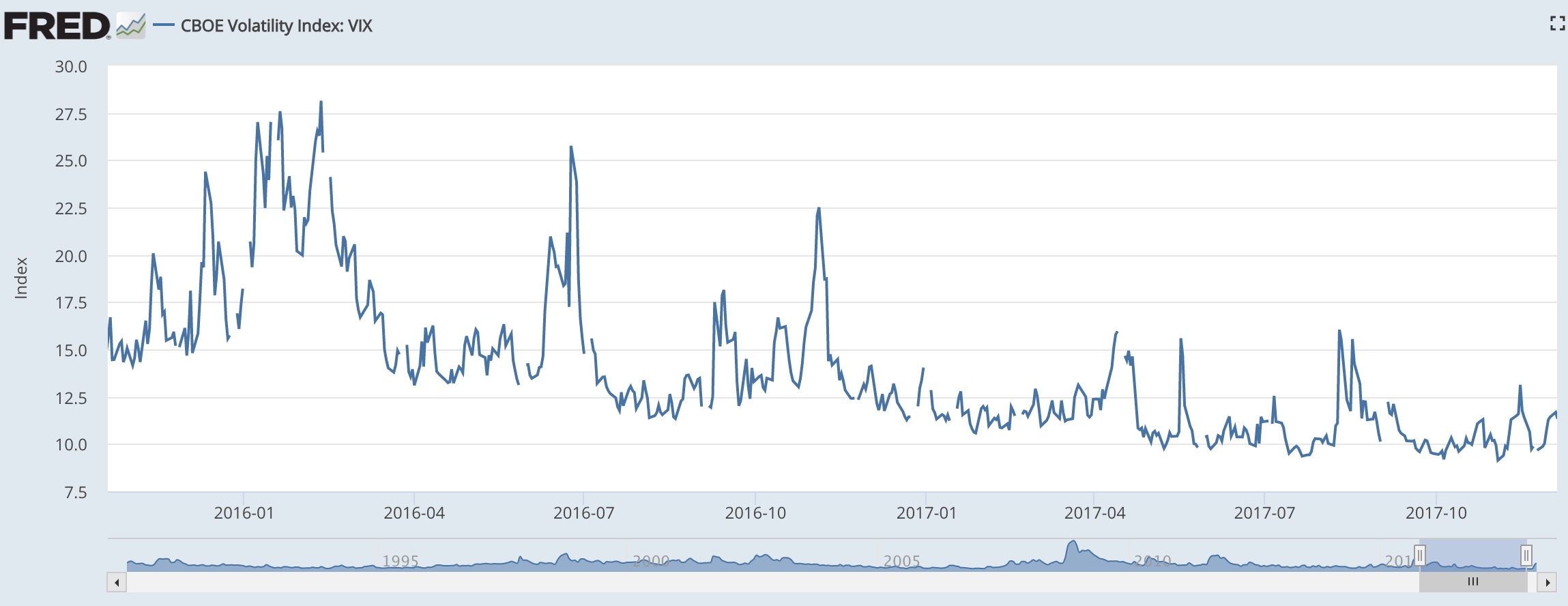
Back in late 2016, I began paying attention to the VIX index. I was personally going through a dark period at the time, and I began looking at the world with an even more cynical eye that I had in the past. When the Brexit tally was completed and signaled Britain’s intent to exit from the EU on June 24, 2016, the VIX shot up rapidly to a peak of about 25, before rapidly decompressing back to about 15 after the next trading day closed. A few months later as the US election wound down, when Trump beat out Clinton, the VIX again shot up before rapidly decompressing.

Mean-Reversion, or the tendency for volatility to return to a historically average value is not at all unusual. In fact, it is almost tautological that volatility must mean-revert. If volatility is a deviation from the average, then there must exist an average state. If something deviates from the normal and doesn’t mean revert, then the original average can no longer be considered the average and will have to change accordingly. But then the deviation will also change, as it will be measured from the new mean, causing it to mean revert.

Screen Shot 2018-02-24 at 5.03.47 PM.jpg
Mean Reversion, VIX median = ~17, mean=~20

Brexit and Trump’s election were important events, and the jitteriness the world felt about the two situations was reflected on the VIX index. Yet in a very important sense, those were the outliers. We might not have known the outcome of Brexit, or the 2016 Election, but we knew that there were going to be a decision. Either Britain was going to leave the EU or it was going to stay. Either Clinton was going to become president, or Trump was (Or perhaps Gary Johnson, but regardless, somebody had to win the election on that date.) This type of uncertainty has definitive certainty to it.

Yet we don’t have to look much further back to the previous peak in the VIX, which occurred in January and February 2016, where the VIX began the year at 15 and reach 30+ twice. What was the reason for that? I have no clue. What about the “Flash Crash” of August 24, 2015, where the VIX shot up to 50+ from an absolutely unknown cause? There were no warnings. What about the August 2011 turmoil due to Spain and Italy’s sovereign debt? Who really saw that coming? What about 2008? The real estate bubble leading to a global financial crisis that nearly blew up the whole world’s economy? The disaster to which Federal Reserve Chairman Alan Greenspan infamously quipped that nobody could’ve seen coming? It is not true that nobody saw it coming. Some people did see it coming. Michael Lewis’s book The Big Short and subsequent movie adaptation did a fairly good job showing that. But the point remains that most people didn’t and they probably shouldn’t be expected to see any of those events coming.

Screen Shot 2018-02-24 at 5.07.04 PM.jpg
2 year VIX Chart, showing volatility suppression. Note: 2/5/18 is not in this chart

In fact, by examining some of the past ups and downs of the market, I soon realized that most of the volatility spikes, and by association market drawdowns occur at times when almost nobody expect them to, and the uncertainties from events like Brexit and Trump are nothing like the uncertainties of these other market reactions. To quote Rumsfeld, Brexit and Trump were known unknowns: you know something was going to happen, you only didn’t know what. But the most severe market crashes and volatility spikes are unknown unknowns: most people don’t even have a clue that something big is about to go down before it happens. Those events are Black Swans.

With that realization, I took a closer look at the VIX chart, and overlaid the S&P500 with it. It became clear that if we ignore the Brexit and Trump votes, since the last real VIX spike in Early 2016, the VIX index has become increasingly suppressed, and the S&P 500 has steadily climbed higher. One striking feature of that graph is how linearly the S&P 500 has been in the last 2 years, and especially 2017. Because the VIX is the volatility of the S&P 500, the less fluctuating (more linear) S&P becomes, the lower the VIX gets, and we can see a very steady downward trend in the VIX below. After the Trump election the VIX closed higher than >16 just once, which I found very odd.

Screen Shot 2018-02-18 at 1.34.13 PM.jpg
S&P 500 and VIX

Philosophically, I have a theory that is crucial for my understanding of the world. First, I believe that good things and bad things can occur randomly. However, for anything deemed good to be more than ephemeral, there must exist at least one solid fundamentals reason for such goodness to continue to exist. But not only that, more importantly is that these fundamental reasons must not decay or lose their effectiveness. On the other hand, this existence of a fundamental force is not necessary for bad things to extend indefinitely, because that is the natural condition.

I firmly believe fundamental human condition is tragic. The tragic nature is the results of the fragility of orderliness in this universe. What we define as good is typically the nonrandom result of a deliberate overcoming of intrinsic chaos. This intrinsic chaos is entropy and is the default direction to which everything in the universe aims towards. It is improbable that nonrandom results (orderliness) will continue indefinitely without deliberate reasons or energy. Therefore, what we view as good always requires deliberate efforts to maintain, to not only suppress the natural tendency to decay into chaos, but to persevere towards higher order and more progress. Again, more importantly, these deliberate efforts must also themselves not lose effectiveness as time progresses. This second-order requirement of a resiliency of the first-order orderliness is often missed and ignored. This is actually just a rephrasing of the law of diminishing marginal return in economics, where the fundamental source of return always loses its marginal worth as the total return expands. Which means, in the universe, not only do orderliness decay towards chaos, but also the energy maintaining orderliness are in of themselves subjects to decay.

Therefore although a few bullish sessions can exist solely by chance, an extended bull market must have a fundamental reason for such prosperity to last, and such fundamental reason must in of itself be sound and robust. Otherwise it is highly likely that the seemingly prosperous times will turn out to be a dangerous illusion. This same criterion is not necessary of a bear market, because a secular bear market where things fall apart is chaotic, the default state of the world. A myopic view of history and aggrandizement of human progress have led us to believe that this past 60 years of exceptional prosperity and relative peace is the default condition for human life, and that couldn’t possibly be farther from the truth. *

*As an aside, I believe that the vitriolic differences between Steven Pinker and Nassim Taleb rest on this point. Pinker believes he sees a fundamental reason that has caused global violence to decrease in our recent past (see The Better Angels of Our Nature.) He does not realize the second-order requirement that this fundamental reason of less violence must not decay. Taleb does not deny that recent history has shown reasonable arguments for peace to exist. However, Taleb views these reasons to be very fragile and can thus cease to exist at anytime, due to a build up of fat-tail risks that can cause irrevocable damage in a globalized scale such as the risks of nuclear war, ecocide from climate-change, or biocide from GMO, etc. In other words, Taleb sees no meta-reason for the reasons for world peace to exist. Thus he has sternly warned in his own caustic prose that these self-congratulatory pats on the back by Steven Pinker and many others is naïve and ignorant.

To understand the current behavior of the market, I thought I first had to find out what the natural state of the market is, beside utter chaos. There is a good reason to expect the market to maintain some order above chaos, because it is human nature for everyone to constantly strive for a better life. And because human nature is resilient and robust, and the population will continue to replace each other, I see it to be fairly reasonable that should the market continue, it would continue to behave in the same way it has always been behaving.

From history, one can see that market volatility is a type of Mandelbrotian wild randomness that is completely unpredictable. Examples of crashes abound, from the 2011 Flash Crash to the 1987 Black Monday and the grand daddy of them all, the 1929 market plunge that started the Great Depression. In his book Misbehavior of the Market, Benoit Mandelbrot creates a convincing exposé via fractal mathematics proving that market risk is fat-tailed, and there is very little one can learn about the tail events of the market from an average and standard deviation (which is volatility).

In the book, Mandelbrot notes two quasi-biblical forces that can explain but not predict market behavior. First there is the Joseph Effect, in which Mandelbrot cites from the Bible where Joseph notices that good harvests tend to last for seven years, and bad harvests tend to last for seven years. Joseph’s recommendation to the Pharaoh is to save up in times of abundance to prepare for times of famine. Mandelbrot notices in the markets that just as Joseph did in harvests, that the good times tend to clump together, and the bad times clumped together. In other words, there is a trend-following tendency in the markets. Mandelbrot called this effect Joseph Effect.

But beyond the clement and mild Joseph Effect is also the erratic and jarring Noah Effect. The Noah Effect is the titanic shifts between the seven years of abundance to the seven years of famine. These shifts are unpredictable and usually catastrophic. Within the market ecology, these are the times when a seemingly bulletproof trend sudden buckles and reverses. This is when entire hedge funds capitulate and large investment banks collapse. This is when liquidity in the markets freezes and prices plunge towards absolute zero. This is when every investor and trader who thought they were smart enough to slip out the fire exit before the cops showed up, comes to the desolate realization that everyone else had the same idea and the fire door is now jammed. Ultimately these are the times when ruinous losses are sustained and incredible windfalls are made. Akin to the biblical deluge of God’s wrath, these market crashes are sudden, catastrophic, and offers warning only to the very few that paid attention prior. The jarring effect here is that when the Noah Effect occurs, it does not matter for how long the trend has been occurring, or how robust the trend seem to be. The deluge of Noah buries everything under its torrential waves.

Another important idea from Mandelbrot is that when the Noah Effect occurs, the averages of the past tells us very little about how far into the deep end this crash will go. In other words, the standard deviation of the S&P 500 (volatility) offer little in predicting the depth of these extraordinary plunges and the average volatility bears almost no relation to the volatility during crises. Options traders have known and studied this concept of “volatility of volatility” or “vol of vol” for quite a while, which mathematically is the 4th moment of a probability distribution (kurtosis.) Kurtosis allows us to conceptually come to term with extremely unlikely events that shouldn’t happen yet have happened and will keep happening. To keep it in biblical terms, kurtosis is the idea that there is nothing in past floods that could have helped predict a flood of biblical proportion.

Thus, if Mandelbrot is correct in his assessment of the market, then it is a structural inevitability that markets combine periods of trends formations with periods of sudden reversals and crashes. And when these crashes and associated volatility spikes happen, we have very little ability in predicting the size of the movements and the damages it will cause.

So I thought in late 2017 that fundamentally we had a situation of immense danger. The extended period of linear growth in the S&P500, with a VIX that is suppressed down from its average by almost 40% (from 17 to 11), is in of itself dangerous given its tendency to return to the average, which would cause the VIX to spike almost 55% (from 11 to 17). Forget the kurtosis and the chance of a biblical flood. I thought a simple rainstorm after this drought would bring this whole thing to the ground.

Given the natural state of the market to be cyclical and abrupt, there are the two questions I wanted to answer: Were there fundamental reasons for the suppression of volatility in 2017? And if so, how stable was this reason and how likely is it to continue to have effect?

To answer the volatility question, I thought about where volatility came from. The answer is market volatility comes from market risk. However, in opposition to what some academics have to so say, volatility per se is not risk. Risk is an unquantifiable aspect of the uncertainty in the future and volatility is the attempt at quantifying that risk. But since you are measuring something intrinsically un-measurable, there are naturally limitations associated with the measurement, thus as long as volatility is used to substitute for risk, there will be shortcomings in the risk models. Part of kurtosis comes from the inability of these risk models to accurately measure tail risks, and even with adjustments such models is still and will always be incomplete and inadequate.

It is often said that the financial market is like a casino, and that just like casinos, the House always wins. To me, that is half true. The house may always win, but the markets are not exactly like a casino. The reason is that while casino risks come from extrinsic bets on the games, market risks are intrinsic to its own operations. In a very underrated book What I Learned Losing A Million Dollars, author Jim Paul explained that market risks comes from the inherent operations of the market, while casino risks is simply created and tagged onto the game itself. If you had ever played a game of poker without betting real money, then you understand that the risk of casino games is not intrinsic to the game, but is only created when you bet money on the outcomes. Meanwhile, no business operation has ever existed without taking on risk. When the grocery store prices a head of iceberg lettuce for 50 cents, the grocer is taking risks on that customers will show up and buy the lettuce, he is taking risk that he will sell enough lettuce at sufficient profit to keep the store open, and he is taking many other risks in addition to that. These types of risks are unquantifiable and can only be estimated with volatility.

The difference between the casino and Wall Street then, is that casino will never put themselves on the wrong side of the odds, because the odds of games are easily calculable. We cannot say the same about the business and market risks that Wall Street has to manage. Sometimes they make errors, and sometimes those errors are huge. The error of this low volatility condition is that Wall Street is pricing and equating risk with volatility, and if risk isn’t actually decreasing with this decreasing volatility, then they must be underpricing the risk. We might have ourselves a situation where we are playing at favorable odds.

So question becomes were risks truly lower given the decreased volatility? Chris Cole is the Managing Partner at the hedge fund Artemis Capital Management, and he has written incredible papers on the divergence between volatility and risk. In one of his more recent essays, he argued that there is a host of both explicit and implicit trades that essentially is betting on stability in the market, in trader lingo, such trades are called short volatility trades. He especially pointed out that there are extensive unrecognized risks in strategies such as risk parity, risk premia, and the leveraged share-buybacks. The gist of the paper was a hypothesis that the trades shorting volatility (bets on stability) has been both the driving force to this low volatility condition, as well as the result of it. In other words, large trades betting on lower volatility had actually led to lower volatility, and the lower volatility then led to more trades betting on even lower volatility because of the first short volatility trades making a profit, then the cycle continues. He found a metaphor to this market in the ouroboros, an Egyptian symbol of a snake eating its own tails. However, in the midst of this self-cannibalization of the market, Cole sternly warned in his paper “risk cannot be destroyed, it can only be shifted and redistributed.”

Cole’s paper got me thinking about whether there are any changes in the intrinsic risks of the market? Federal Reserve’s Quantitative Easing program had supposedly ended, and talks of rate hikes abound, and that is risky for the bond market. A few tech stocks (FANG) have been the bullish force driving much of the growth of the S&P500, and concentration is always risky for the equity market. The big banks that crashed the world economy in 2008 got even bigger. Real estate prices in many parts of America have gotten back or even exceeded peak prices before the crash of 08, and Canada and Australia’s real estates markets are showing obvious signs of distress. China has started to show signs of slow growth. There is also brewing geopolitical risks overseas. While at home, there is obvious sociopolitical tension between the populist and progressive, the liberal and conservative, and even generational tension between the Baby Boomers and the Millennials. All of these things are risky. Let’s not discount the fact that the government actually shut in January of 2018 and national debt was approaching 20 trillion at the end of January, which is more than $60,000 of debt per citizen. And these are only the known risks. How many additional tons of dynamite is out there that I don’t see is scary to think about. So I think it is safe to say that risk have not been reduced.

Therefore, regardless if there are fundamental reasons for the decrease of volatility, there are no reasons robust enough to reduce market risk. And volatility is used to price risk, and since risks cannot be destroyed, this divergence between risk (the same) and volatility (decreasing) must eventually re-converge, and volatility must inevitably spike.

It was under ideas like this that I found the suppressed volatility very concerning from a fundamental level, because I could not see a reason for volatility to be this low, given that the risk is anything but decreasing. Next I looked at it from a psychological aspect. Not only was the S&P500 rising and VIX dropping, but people are also really starting to believe in this false narrative and much like the ouroboros, it is feeding back upon itself.

I have found that the main reason people invest in ongoing bubbles is not because they necessarily believe that the prices will never come down. It is my experience living through the real estate bubble in the mid 2000’s that many cautious people finally jump in to invest in bubbles right at the top because their fear of not being able to afford a house in the future finally exceeded their fear on buying a house that loses value. The similarity was not lost on me when a friend told me last year in regards to his IRA that he couldn’t afford to not be fully invested at this point in his career. He was barely 30 years old. It is as Livy once brilliantly stated and Danny Kahneman later rediscovered in Prospect Theory, that “men feel the bad more than the good.” For retail investors, it is rarely greed that dispels the natural fear of losses. It takes a fear to exorcise a fear. In this case, it is the fear of missing out (FOMO) that makes average people make terrible financial decisions, often at the worst times. The amount of investor money pouring into Credit Suisse’s XIV ETN that explicitly bets on ever lowering VIX and the reports of a former Target manager turning his life savings into 8 figures by a short volatility strategy solidified my sense of investor euphoria, and hinted to me that the end is probably be near.

So with my analysis complete, I decided to bet against the continuance of the low volatility condition back in late 2017. So I began a simple strategy of long volatility. I will not bore you with the actual options I traded, but in layman’s terms, I would place bets that volatility is to increase and slowly waited on a potential windfall payday.

On February 5th, 2018, the fateful day I waited faithfully for finally happened. As mentioned earlier, the VIX surged 118%, closed at 37, and rocketed another 30% more the next day, ultimately to a high of ~48 before retreating back. The S&P500 also experienced one of its worst days in a few years, drawing down nearly 5%. Was this the big one?

In Dino Buzzati’s poignant novel, The Tartar Steppe, the protagonist Giovanni Drogo is a soldier sent to a small barren outpost, with a mission to prepare for a possible invasion from the northern steppe. The novel is a beautiful composition detailing the immense pain and agony that people suffer when they hand over everything in their present for an uncertain but possibly glorious future. In the novel, Drogo patiently trains and waits for the enemy to rise over the northern horizon year after year, while his friends, family, and everyone he cared about in his old life moves on or disappears. Eventually he has nothing left in his life but the illusory enemies in the northern steppe and the excruciating hope for a glorious battle. Yet when the invasion finally occurs decades later, Drogo has become an old man, cruelly incapacitated by age and disease. Drogo is discharged from the post, and the book painfully closes with him taking his final lonely breath in an inn by the side of the road while the battle happened. He had missed it.

On February 5th, 2018, my enemy finally appeared upon the northern horizon of the tartar steppe. But just like Drogo, I had missed it.

I didn’t put on the trade that would’ve landed a windfall. And what a windfall that would have been. Retrospectively, had I put on the trades I had on in the previous month, It would’ve profited north of 4,000% of my original investment. I had done all the research necessary, I had made the contrarian call and I was proven right. I saw the Black Swan event from a mile away but I was ultimately not able to capitalize.

Why did that happen?

To me, it was a lack of discipline that had me sitting from the sidelines during one of the most exciting moments of my short trading career so far. Although I had little doubt that this barrel of dynamite that I sniffed out was eventually going to blow up, what I didn’t know was what the trigger was going to be, and when the trigger was going to be pulled. These long volatility trades I put up had negative carries, which meant that I would be paying premiums for options that lose value and expire as time pass. Thus if this low volatility were to continue despite all reason, the lost options premiums may potentially exceed the eventual gain. I remember constantly thinking about Keynes’s quote, “the market can remain irrational longer than you can remain solvent.” So I will admit that it was an extremely painful trade. The almost daily downward ticks in the brokerage account is almost like Chinese water torture, constantly reminding me with each maddening water drop, of the sustained losses and forced me to needlessly doubt my trade incessantly. Ultimately inability to face this pain led to me miss out on the battle of the Northern Steppe.

But now I know that the pain of losing a manageable amount of money in premiums is nothing compared to the pain of watching the barrels of dynamites exploding exactly as you predict, yet having no profits to show for it. I should not have been worried about the timing of the trade at all. If making the exact right trade at the exact right time is the goal, then it is an impossible goal that nobody will consistently reach. What I can hope for as a trader is only that I make roughly the right trades at roughly the right times. My mistake this time was that I looked for certainty in an uncertain world. Perhaps the market would’ve remained irrational and the low volatility condition would’ve continued, but there is no information in the world before Feb 5th that could’ve eliminated this bit of uncertainty. Given the research that I’ve done showing good odds for a volatility spike, and given that the cost to play in terms of option premiums were at historical lows, it was a major misstep that I did not take advantage of such condition.

But without a disciplined system, I was not able to keep up a consistent trading habit. It allowed my emotions to take control of my trading, which is never a good idea. Some months, I would see the VIX climb a couple of point during one day, and I would sell my position at a small profit and re-enter the trade when the volatility dropped back. Other months, every option I held would expire worthless as the VIX never increased, and I’d be out the entire investment I put into those options. I mistakenly never created systematic entry points and exit points. Not having a system gave me the freedom to enter and exit at whatever point I chose convenient, translation: I entered and exited on my whims, without any thoughts, based solely on emotion.

Jesse Livermore once said “ It never was my thinking that made the big money for me. It always was my sitting.” He was referring to being patient in the market, and not allowing the noise of the market to pulse through the signals. I was not able to have patience and sit on my strategy until payday. Fortunately, I am learning this lesson early without suffering a big loss besides a few months of cheap options premiums. This lesson is paid in full by opportunity cost. It is a lesson that I will take to heart as I continue to explore this market.

Not everything that shines is gold, and why not every bit of savings matter

I was talking to a friend the other day about personal finance while at Starbucks. The dilemma was whether or not she should continue to take the Bay Area public transportation to work, or start driving. Ironically, driving would be cheaper, but not by much, the cost difference was roughly $15 a week. To throw the dilemma of perpetuity out of the question, she is also planning on moving and switching jobs in 4 months.

A rough calculation taking in consideration only the difference between gas cost and public transportation fees shows that at a difference of $15 a week for 4 month would save at most $300.

15 dollars/week x 4.5 weeks/month x 4 months = $270

The result also includes a $30 margin of safety accommodating for some combinations of an increase in transport fees and/or a decrease in gas prices that result in a net increase in total savings. We will ignore situations that result in less net savings (some combination of decreasing fees and/or increasing gas price.)

When I brought up the relative insignificance of $300 over the 4 month, and that given the stress of driving in traffic, I probably would choose to continue taking public transport. The response was the sound bite of the personal finance gurus of the world: “but every bit counts.”

Eh, no it doesn’t.

The rifles of personal finance gurus seem to always be aimed at these insignificantly small cash expenditures. They’ve termed these expenditures microspending, and the $3 latte at Starbucks is the favorite punching bag for many. Other targets include frequent haircuts, bottled water, and more recently, an Australian real estate mogul denounced avocado toasts to be the cause for Australian millennial’s inability to afford home ownership. Right, because the $15 spent on avocado toasts is the reason why young people cannot afford million dollar Australian properties. It is definitely not the fact that Australia has seen a massive influx of foreign investors sautéing the real estate market, pricing the properties completely out of reach, and forcing Australians to keep up with a higher household debt-to-GDP ratio than even Canada1 (with its own housing bubble primed to explode). According to Rider Levett Bucknall’s Crane Index, Sydney alone has more cranes (350) for residential building than all of North America combined (<200)2, Is that not a sign of a overextension? Yet Australian millenials shying away from these spectacularly stupid speculative properties is not viewed as a sign that the real estate market might be overextended and overpriced. The grown-ups have chosen to blame the Australian millenials for spending their money on lattes and avocados instead of sheepishly sing to the slaughterhouse and holding the bags of these overpriced properties. It’s one thing to criticize the lack of saving, it’s completely different when a real estate mogul criticize a generation for not buying (his) real estate.

Property bubbles aside, the issue with microspending is multi-leveled. At the first level, the calculations often done to show how much these microexpenditures compound is naïve at best, down right misleading at worst. At the second level, the vilification of microspending ignores some important principles of human psychology. Both of which leads to the third level of error, the ignorance of nonlinearities of life.

Bad Math

In Alice Schroeder’s biography of Warren Buffett Snowball, there was an interesting passage of Buffett estimating his savings to be $300,000 if he just lengthened the time in between his haircut appointments. Yet Warren Buffett did not become rich by penny pinching on haircuts, he got very rich by being one of the greatest value investors of all time. A naïve interpretation of this would be “if Buffett pinched haircuts and he’s rich, I can get rich by pinching haircuts.” This is a bad take and ignores that the haircut pinching advice being public is conditional on Buffett’s success, not the other way around. In other words, without such sharp eyes for mispriced intrinsic values, Warren Buffett would not have found his wild success, and the whole haircut thing would be lost in irrelevancy. It wasn’t the haircut that made Buffett, it was Buffett that made the haircut.

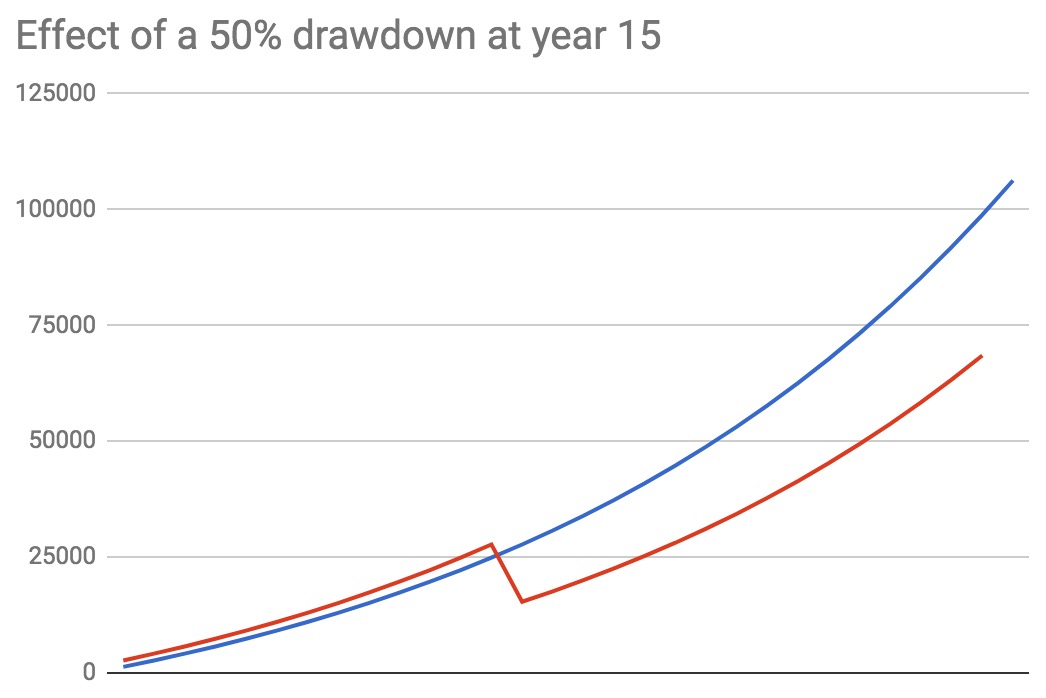
Yet it is naïve takes like this that gets the attention. A $3.50 daily latte, compounded over 30 years at 6% is worth $106k, according to a Business Insider article3. Yet this simplistic calculation is not adjusted for inflation, does not take into account tail events of various kinds, and assumes too stable a compounded interest.

First, if we take inflation into consideration, assuming we take the Fed’s 2% target at face value, then the nominal 106k in 30 years only has real purchasing power today of $58k. In other words, if you are putting in a non-inflation adjusted $1260 every year for 30 years ($37,800 total,) your compounding account will actually give you only about $58,000 of purchasing power at the end of 30 years. This is adjusting for inflation at the output. Another way to think about inflation would be that the cost of the latte would rise 2% a year due to inflation, so in order to save the increasing cost of a latte, the amount that’s necessary to be put into the bank would increase 2% a year. This is adjusting for inflation at the input, and by the 30th year, each latte would cost $6.33 each instead of $3.50, and your yearly contribution would have increased from $1260 to $2238. In this case, then your inflation adjusted output of $106,000 at the end of 30 years would require an input of $51,116 over 30 years. So as you can see, it’s not as astronomical a return as it originally seemed, because the pernicious effect of inflation is a compounding effect as well.

Second, we would look to add tail risk into the model, where we induce a 50% drawdown in the middle of the 30 years due to a stock crash, which is not an unreasonable assumption (remember 2000 and 2008). In this case, in the 15th year of the 6% annualized return, the compounding interest would have reached $30,700, and the market crashing 50% brings your portfolio value to $15,350, and you start compounding again at 6%. After 15 more years, your total balance is only $63,265, again not counting for inflation. One word of caution is this, if the drawdown occurs early, it does not matter as much. If a drawdown occurs late, it does massive damage to your portfolio. Extreme examples are 50% drawdowns occurring in the first year, in where you see your losses at $600, compared to the 30th year, where the damage totals over $53,000. There is no way to tell which years this will happen, and shows the importance of hedging tail risks, especially as you approach the end of your investment horizon.

Screen Shot 2018-02-10 at 7.32.08 PM.jpg

Bad Psychology 

Danny Kahneman’s book Thinking, Fast and Slow is one of the most important book published in the last 20 years, and is a book I recommend to everybody. However, what I found to be one of the most pernicious systemic biases was almost glossed over in the book, and is worth taking a look at here. Ego depletion, Kahneman writes, is the finding by psychologist Roy Baumeister that “all variants of voluntary effort (cognitive, emotional, or physical) draw at least partly on a shared pool of mental energy… and has repeatedly found that an effort of will or self-control is tiring; if you had to force yourself to do something, you are less willing or less able to exert self-control when the next challenge comes.

This is an incredibly important insight with far-reaching consequences. For one, it is a subtle refutation of the common idea that the initial inertia of making a change is the most difficult. The experiment provides counterevidence that it actually gets more difficult as time goes on. One way to view the results is the static view that longer you hold off that piece of cheesecake, the more difficult it will be for you to hold off that piece of cheesecake. A slightly more dynamic view however, is that the longer you hold off that cheesecake makes you more likely to eat a tub of Haagen Dazs later, or to eat an extra slice of pizza later. But the most important implication of this study is that all of these mental effort draws upon the same proverbial mental gas tank of discipline, and that the more effort exerted to deprive yourself of an occasional slice of cheesecake might lead you to go on Amazon and order a new TV, or to engage in other risky activities that has nothing to do with the original activity precluded yourself from partaking. The subtlety here that Baumeister discovered is that life is not a simple system of isolated events in a vacuum having nothing to do with each other, life is a complex system with many interacting forces that are all entangled with each other in an intricate web. In other words, the act of exerting self-control to refuse spending $3 on a cup of coffee does not end with you walking away from Starbucks declaring victory over your impulse, but it will continues to have an effect on you in the future. So two seemingly completely unrelated activities such as refusing a cup of coffee a couple of days ago and splurging on a new jacket today might indeed be deeply connected. This is something rarely explored in academia, because to explore what the higher order effect of an action is, one has to be aware of where to look. Yet if one knew where to look, one would tautologically already know about those higher order effects. It’s a complete Catch-22. But in this case, Baumeister have become one of the rare academic psychologists to discover the process of something that is inherently dynamic and thus applicable to real-life. So one has to at least keep in mind the possibility that an innocuous act of declining the impulse to spend $3 on coffee might lead to more expensive splurges later on.

Bad mindset

So far we’ve looked at bad math and bad psychology of a popular personal finance dictum of every bit of saving matters. The arguments above is not meant to discourage saving. Saving money is a good habit because the saved capital is what provides the cushion to be able to take risks that drives life forward. However, it must be realized at this point that is it does not matter howoften you manage to be frugal, but it only matter how much you save in total. In other words, it matters not the frequency or duration of self-discipline, it matters what you exhibit discipline in and what the payoff for that discipline is. It is the payoff function that matters in life. So here lies a wonderful example of nonlinearity in life, because if Baumeister is correct, then it is completely reasonable to think that it may take much more mental effort to save $1000 by skipping 300 trips to Starbucks than it does to simply avoid buying a new TV once next Christmas. In fact, by forcing yourself to skip Starbucks so many times, you might be unnecessarily incurring a very significant risk/cost upon yourself by depleting a very finite supply of discipline and increase your chance to make a very large foolish financial decision somewhere down the line that wipes out all savings accomplished. Penny-wise and pound-foolish is a sure ticket to the poor house.

Bibilo

1.http://www.abc.net.au/news/2017-12-11/australian-real-estate-vulnerable-to-variable-interest-rates/9237202

2.http://assets.rlb.com/production/2017/02/01000131/2017-01-Crane-Index.pdf

Click to access RLB-Crane-Index-Australia-Q4-2017.pdf

3.http://www.businessinsider.com/how-to-make-iced-coffee-french-press-daily-cup-costs-100000-2017-7

A Bit of Skepticism on Bitcoin

As of time of this writing, Bitcoin have just smashed through $14000, $15000, $16000, $17000, $16500 with a year to date yield of over 1000%. It is dominating all other yields in a year where general market trend almost everywhere has been bullish, with global equities valuations pushing all time highs.


Bitcoin is a David and Goliath story. It’s a story of an unlikely invention by a mysterious genius reshaping the realms of finance, taking out the financial middleman and bringing a decentralized left hook straight to the mouths of the centralized financial systems of the world. It is digital gold.

Or it was supposed to have been.

Yes, bitcoin is enjoying an absolutely meteoric rise in its dollar term worth. Yes, the blockchain is a revolutionary idea that has the potential to reshape the world like the Internet did. But it is important to remember that the Internet revolutionized in ways and only in ways that nobody initially thought it could ever do. In other words, almost all of the successful functions of the Internet of today, from social media, to YouTube, to Wikipedia, and e-commerce were not planned or even imagined at its inception. The reasons for that are too many to explore here. This however, brings me to my first argument of skepticism towards bitcoin, that people are confounding bitcoin with blockchains. To make the analogy simple, if we’re going to call Blockchain the Internet, then Bitcoin is just one function of the Internet, and it has just as much chance of being the next Google as it does the next Pets.com. It would be foolish right now to try to predict which of the forking paths bitcoin will take and where bitcoin will end up in the future. Bitcoin and all other cryptocurrency is currently a use of the blockchain technology, but blockchain technology and all of its other potential uses far surpasses mere cryptocurrencies. Again, to use the analogy to the Internet, yes you can use the Internet to send encrypted electronic mail to your friends, but that’s not all the Internet does. In short, the survival of bitcoin is not necessary for the success of the blockchain technology, and the argument that blockchain is going to elevate bitcoin into the stratosphere actually severely underestimates the potential of the blockchain.

The second point of skepticism I have towards the future of bitcoin has to do, and I apologize for the sickly pun, with futures. Both the Chicago Mercantile Exchange and the Chicago Board Options Exchange have both recently announced that future contracts will be standardized and clearinghoused through both exchanges. This is extremely important news for bitcoin as the presence of such derivatives, as well as the institutional investors such derivatives bring can have profound effects on the prices of the underlying bitcoin. As of right now, I do not have a clue how the futures will affect Bitcoin, but it is certain that an additional layer of complexity is entering the game, and with additional complexity comes additional risks, even in the underlying market.

Thirdly, the most troubling question I have for bitcoin is in regards to the state of its original function, a cryptographically secured digital currency. I believe I see a very fundamental problem in that almost all supporting arguments for bitcoin (aside from those touting the potential of the blockchain) are advocating for bitcoin the currency, not bitcoin the tradable asset. I believe that this current spectacular boom can be explained by the market’s lack of awareness of this confounding problem, and will have huge corrections once this error is realized. So we will explore what it is that bitcoin was originally intended to be, and what it is now.

Bitcoin was supposed to be money. For something to be money, it must serve a few basic functions:

  • Unit of Account: Money need to be numerical, as it functions to assign an arithmetical relationship between different objects in the world. Divisibility is of utmost importance here and is why a cow is a bad form of payment, because you can’t pay in ½ of a cow without killing it.
  • Medium of Exchange: Money need to be widely trusted by people as something that can be exchanged for many other things. This function of money is crucial and can be visualized in a thought experiment to the time of the barter system. If we imagine that I have some extra wheat and you happen to want to bake a loaf of bread today. You have some grapes that I would like to eat immediately. I will then, after reaching a deal, exchange with you a certain amount of my wheat for some of your grapes. However, because the wheat does not perish as easily as grapes, if I gave you more wheat than you needed for the bread today, you will be able to keep the grain for longer and potentially consume it later or exchange it for something else with another person later on. But as for the grapes, if I don’t finish those within a couple of days, I had better start turning them into raisins. So there is a much smaller chance that I will be able to use the grapes for exchanges in the future. Thus over time, it is not hard to imagine that more and more wheat makes it to more and more people’s households from exchanges like this and become the exchange medium of the village. Eventually, wheat will become so widely exchanged not just because of its value to make bread, but also because of everyone’s trust in the ability of wheat to be exchanged for almost anything else. This trust is crucial, and for this trust to develop, the commodity must have some durability, as well as divisibility, and portability. However, we can see from this thought experiment that in a decentralized bartering system, what allows a commodity to be come a medium of exchange in the first place is that it possesses certain intrinsic value in of itself. This initial intrinsic value can be an aesthetic value (e.g. pretty seashells, shiny precious metals,) simple scarcity (rare gems,) or actual utility value that nonprecious metals or wheat has to offer. Without this initial intrinsic value, people would never have exchanged for it in the first place. Would you accept a random common pebble for the grapes? Even though small rocks are durable, portable, and divisible, without this initial intrinsic value, it can never get started as a medium of exchange. So in a completely decentralized system, which is what bitcoin want to operate in, the value of money can be described as the sum of its intrinsic value (e.g. wheat as bread ingredient) plus its accepted value as a medium of exchange (e.g. wheat as currency). This explains why precious metal eventually took over as the de facto money in history. They don’t degrade, they’re easy enough to carry around, they’re scarce, they’re divisible, and they have just enough intrinsic value that people wanted them for what they are in the initial barters. In the advent of fiat paper money later in modernity, the intrinsic values dropped to zero, and the exchange value for these new fiat money became its sole value, and resides in the government’s power to enforce (via violence) contracts and tax. Thus we can have illogical situations like how the value of the metal content in a nickel coin is actually greater than 5 cents, but you can never use it as such without melting it down, which is technically illegal. This type of situation would never arise in a decentralized system, as there would simply never be any entity intentionally taking losses to force nickels to be worth 5 cents. This centralized monetary system was the beast that bitcoin the currency took aim to bring down.
    • Now some have argued a bartering system probably never existed (See David Graeber’s book Debt: First 5000 Years). It was just simply not a very practical system if you really think about how it would function. For example, bartering would work terribly in a situation where I need some chickens today and have a pig to exchange for it, but you don’t want another pig today. With pigs being not very durable, divisible, and portable, it never had a chance to become a medium of exchange. The only way to solve this problem is to find a third (or fourth, or fifth, etc) party that want my pig and have a bottle of wine that you want to complete this trade in a barter system. An example of this inefficiency in barter is the trades that occur in the NBA where a 3rd team is often necessary to facilitate the player swaps, and these trades take days to complete. The source of the limitation to a pure bartering system is in the timing, because bartering requires all involved parties to make the exchange at the exact same time. Graeber argued that it is much easier for a small economy to get started with a rudimentary credits system instead. How that would work is that if I needed a chicken, but you don’t want the extra pig right now, I’d just come to you and ask for the extra chicken that you have today. You’d give the chicken to me and we would both keep an informal IOU that “I owe you something roughly the value of a chicken.” Later on when you find out that I have traded away my extra pig and received a few bottles of wine that you would want to drink, you simply just come to my house and just ask for a bottle, and I will gladly give it to you, for the chicken that you gave me a while ago. Our informal IOU is cleared and we both move on with our lives. This is what a rudimentary credit system looks like, where the credit exist to allow for inter-temporal trades. This system works much more efficiently than a pure barter, as long as each participant can assess counterparty credit risk well enough. The increased complexity here compared with pure barter is the presence of credit risk. While bartering is inefficient, the very inefficiency eliminates the opportunities for any party to receive something then refuse to pay back for it. So it is important that in a rudimentary credit system, that people only participate with people whose creditworthiness that they know well. The limitation due to credit risk in a rudimentary credit system is obvious once you need to trade with a stranger in the next town over. Once you have to trade with people that you do not know personally, a system of common and trusted medium of exchange must necessarily emerge, to lessen the need to assess creditworthiness.
  • Storage of value: Lastly, money should be able to hold it purchasing power consistently and predictably. In short, if I exchange a bushel of wheat for 5 chickens today, should I want 5 more chickens tomorrow given that there are enough chickens available (jargon: if the liquidity is strong), I expect to be able to exchange for 5 additional chickens with 1 additional bushel of wheat. It would cause a major problem for wheat as money if I find tomorrow that my 1 bushel of wheat can only exchange for 2 chickens. Without an ability to uphold to the expectations of money to store value consistently, it becomes very risky to give and accept the currency.

Now let’s see how these functions apply to Bitcoin.

  • Unit of Account: Bitcoin does this exceptionally well, much better than any other currencies of the past. Due to its digital nature, it is easily countable and divisible into the most infinitesimal of units.
  • Medium of Exchange: The most accepted currency in America is still the fiat dollar, and you’d be hard pressed to find too many places accepting bitcoin. But to be fair, it’s almost impossible to get anybody accept anything other than dollar as payment these days as well. It is the battle that bitcoin the currency is trying to fight. The government has a monopoly on money production and money transaction. Almost all transactions within the United States is dollar-denominated and recorded and reported to the IRS for tax purposes. The government has centralized currencies and the many financial infrastructures used to facilitate transactions. As with any monopoly, the government also instituted many rigid bureaucratic rules and regulations in order to protect their monopoly in creating money and its facilitation. Both private and public institutions take advantage of the inefficiencies in these regulations, but ultimately it must use the governmental financial infrastructures, as there aren’t any alternatives. The initial idea of bitcoin the currency was that it has created through cryptography and blockchain, new form of private money that exists on the Internet. This new form of private money bypasses all of the present governmental financial infrastructures, and presents users the ability to make exchanges without paying the proverbial toll to use the highways that the government has set up for all financial transactions. The key to any commodity of becoming a medium of exchange is its widespread adoption, and this is the hurdle that bitcoin the currency have yet to be able to overcome. The reason for this slow adoption is multi-fold, and is too long to be discussed here. I will only discuss one reason, which is related to bitcoin’s problem as storage of value.
  • Storage of value: This is where bitcoin has its biggest issues at becoming as a bona fide currency. As described above, for something to be accepted as mediums of exchange, it cannot have wild fluctuations in its value storage. Regardless of your opinion on bitcoin, one undeniable fact is this: a bitcoin today is probably not going to hold the same purchasing power as a bitcoin tomorrow. Usually with most money, it is the inflationary risk that’s worrisome. If a currency is continuously losing value at a rapid rate, you’d want to spend it quick and exchange for something that holds its value more stably, and you’d be hard pressed to exchange anything for such a currency. So you’d have excessive supply of the faltering currency with no demand, which reflexively lead to further decline in purchasing power of the currency. This is how economies falls apart in times of hyperinflation. This current situation in bitcoin presents the opposite. The bitcoin rocket ship blasting upward with no end in sight means that nobody is willing to spend bitcoin as a currency. Because should you use it as currency, you run the very real risk of paying an exorbitant amount in futures dollars for something like a pizza as somebody did in 2010 (@bitcoin_pizza on twitter). In this situation, supply of bitcoin the currency sharply decrease, and demand for it sharply rises, which reflexively leads to further increase in bitcoin’s dollar-price. Because its value is not stable, nobody is using bitcoin to buy things. Because nobody is using bitcoin the buy things, it is not a medium of exchange, and it is thus not money.

The idea of the bitcoin the currency is wonderful. What bitcoin and other cryptocurrencies revealed, is the postmodern idea that a lot of iron laws of society are simply illusions. In the movie Margin Call, there was a line that I think will resonate with every bitcoin bull. “It’s just money. It’s made up. Piece of paper with faces on it so we don’t have to kill each other just to get something to eat.” What bitcoin shouted to the world is that money is nothing but a made-up medium of exchange that holds value and numerates thing. So what bitcoin aimed to do was to create a decentralized and nonphysical medium of exchange on the Internet, where the intrinsic value would be the utility of an entirely new alternative paradigm to the governmental monopoly over financial transactions. If this is combined with widespread acceptance, it can easily become an extreme force to reckon within society.

As most bitcoin bull will tell you, it is this incredible potential to uproot the entire financial system as a new currency that gives bitcoin the ammunition to sustain this momentous rally. But the ironic reality is that it is precisely this meteoric rise and incredible volatility in its dollar term worth that has made bitcoin far too volatile to function as a currency. The original vision of bitcoin was for it to untether from the dollar and become alternative private money for private transactions bypassing governmental interferences. This current version of bitcoin is little more than a increasingly scarce commodity whose demand far outstrips the supply in the market, with classic positive feedback mechanism reinforcing this scarcity. By being a valuable idea, the idea suffocated itself. It is this unfortunate piece of reflexivity that gives me the opinion that bitcoin be currently looked upon as a commodity with epistemologically opaque fundamental valuation, and not a currency. Thus if the above arguments are true, then we must realize that all recent price action have been driven by speculative pressure towards a false paradise, and not for any realization of revolutionary fundamental value. Icarus, meet bitcoin.

I love the idea of bitcoin, of cryptocurrencies and of the blockchain. In an age of increased governmental involvement in people’s private lives and decreased liberty, the emergence of the blockchain glimmers brightly in the dark. So allow me to be skeptical of my own skepticism and offer a few lines of speculative gibberish on where I see things going potentially.

As I have stated above, the fundamental value of bitcoin the asset is unknown and unknowable at present times, but we know that it is associated with the blockchain technology. The fact that my first argument points to that success of the blockchain do not necessitate the survival of bitcoin does not invalidate the possibility of such a contiguity. My thesis is that I do not think the probability of bitcoin becoming the revolutionary new currency is very high given its current inability to store value, and that the arguments made by bitcoin bulls that cite bitcoin the asset’s rally as evidence of bitcoin’s future utility is logically fallacious. Also due to the exposure of bitcoin, a large correction now would almost certainly damage bitcoin’s reputation and its adoption as a currency in the future. However, I do not believe that even if such a correction is to occur, that it would mean certain death for bitcoin. Stranger things have happened in this world. I think at this point, the practical approach towards the future of bitcoin (and i would argue the future of anything) is agnosticism. All I have said is that at these current prices and more importantly, the rate at which these prices have been climbing, odds are high that this is simply speculative build up. However, if more information is to present itself, such as the appearances of people actually using bitcoins as mediums of exchanges, that should signal one to change their minds. The ultimate beauty of the human mind is not in its rationality, but rather its adaptability to a changing world. When information change, one’s opinion should change.


Hurricane Harvey, Probabilities, and Wittgenstein’s Ruler

Screen Shot 2017-08-30 at 8.53.57 PM.jpg

Hurricane Harvey is termed to be a 500-year event. The problems with labeling it as such is multi-fold.

First, it is confusing to call something a once-in-500 year event. People don’t live for 500 years. There are very few things that live for 500 years. It is essentially outside of the scale of human biology. To say that something is a once in 500 year event is the same as saying there are stars 100 lightyears away. We have no mental framework to understand how far 100 lightyear is, nor do we have any mental capacity to understand how long 500 year is in relation to our personal history. It is the time difference between now and when Columbus first set foot in America.  If we think about how much has happened since then, it is basically meaningless in everyday language. Thus it is confusing to call something a 1-in-500 year event.

Second, it is pragmatically unwise to call something a once-in-500 year event. There are quite a few articles mentioning and explaining that a 500 year storm does not mean that it is a storm that happens only once in 500 years. What it really mean is that this storm has a 1 in 500 chance (0.2%) of occurring each year. The practical problem with this wording of something to be a 500 year event is that it actively induces the Monte Carlo Fallacy. The Monte Carlo Fallacy is the belief that if you’ve flipped a fair coin and it came up heads 4 times in a row, it is more likely to even out and come out tails the next time. An event with a 0.2% chance of occurring each year has a 99.8% chance of not occurring. This actually means it has a 1 in 3 chance of occurring within as little as 200 years. The algebra is as follows. (1-0.002)x = (1-0.33), solving for x. It also means ironically, that within a 500 year period, a one-in-500 year event only has a 63% chance of actually occurring at least once. (Taking 0.998500 would obtain the probability of such an event NOT occurring in 500 years, subtracting that number from 1 would obtain the probability of such an event happening at least once within 500 years.) So it is simply poor wording from a pragmatic point to label these events as 500 year events. Note, this is the main statistical explanation that most mainstream news article gives to why 500 year events are occurring more often.

As an aside, it might be interesting to see how a 100-year event would perform in a time span of 500 years. Mainly what I mean is the question: How likely is it for an event with a 1% yearly probability to NOT occur even once in 500 years. So here, we know that this event has a 99% chance of NOT occurring each year, raised to 500th power would give us the odds of it not occurring once in 500 years. The answer is 0.0065, in other words, 0.65% of the time, a 1-in-100-year events may not happen at all over 500 years. Aside #2: the chance of a 100-year event masquerading as a 500-year event, (i.e. the probability of a 100-year event happening only once in 500 years) is about 3.3%. The math is as follows: 500 x 0.01 x 0.99499.

Lastly, and I believe the most important problem with such labels is that these “500-year storms” are not truly 500-year storms. One must realize that these labels are simply extrapolations from historical data, and historical data, especially historical data of tail events are always incomplete, simply because there hasn’t been that many 500-year periods in recorded history. If we remember the initial argument, 500 years on a time scale is about the time passed since Columbus’s discovery of America. Now if we consider the second argument above, the probability of a true 500-year event only has a 63% chance of occurring in 500 years. Thus it is impossible to accurately label something a 500-year event if there is not 500 years of data, and that even if there were 500 years of data since Columbus’s initial landing, we have shown that we still cannot be confident at all about the label. All of this brings me to my ultimate question. Can we confidently call Harvey a 500-year storm? I believe the answer is a definitive no. Thus it is no longer a mystery why Houston has supposedly had multiple “500-year floods” in recent years. Because these 500-year events are not really 500-year events! If a “500-yr event” occurs more frequently than roughly every 500 years, then it is far more likely, given the incompleteness of the data, that the probability was originally misjudged rather than there being any concrete underlying changes in the probability itself. The probability of a true 500-year event occurring even once within any 3 year frame is 1-0.998^3, or ~0.59%, and to have had multiple occurrences exponentially reduces that chance even further. In other words, striking a 1 in 500 event once in 3 trials is 0.59%, twice in 3 trials would be 0.00592 or 0.0035%, and the probability of what the Washington Post article attached below is suggesting, that this is the third time a 500-year event has occurred in three year, would be a puny 0.00002% (1 in 5million). The point venues like New York Times and Washington Post is trying to make is that this type of catastrophes could be due to the underlying climate changes from global warming that altered the probability of what was once a 500-year event. That could be true, but such claim would require much stronger evidence than simply showing that something purported to be a 500-year event is in all likelihood, to not be a 500-year event. The problem with using every catastrophe as a platform for climate change is that it is a false platform, and it misinforms the audience about climate change. I believe this recent backlash against science is deeply rooted the media’s overzealousness in plating to the public serving after serving of undercooked scientific studies. When the readers of such venues read one too many report of a scientific claims that later becomes falsified, it is the same feeling as eating one too many piece of undercooked chicken. The result is a visible disdain and distrust for science.   We as a society must respect science for what it is.  Science is the process of pursuing the truth, and not the truth itself. The more we toss “climate change” as a buzzword and a sound bite explanation for everything, the less receptive the general public are when it comes to true discussions in regards to climate change. NYT and WaPo must stop blaming climate change for everything, stop watering it down, and stop undermining the platform that true scientist spent years building.

To end, I will quote an idea from Nassim Taleb. He called it Wittgenstein’s Ruler. Its basic premise, which Taleb associates with the philosopher Ludwig Wittgenstein, is that since a ruler can be used to measure the length of the table, the corollary would immediately be that if given uncertainties in regards to the length of the ruler; the table can be used to measure the ruler. In this example, I have shown that a model can be used to estimate the probability of an event, the corollary being that the probability of the event can be used to assess the accuracy of the model.

Antifragility and complexity 

“The entire idea of via negativa is omission does not have side effects and the branching chain of unintended consequences” -Nassim Taleb
While I didn’t used to understand antifragility besides the superficiality, now it is clear to me that what Taleb calls antifragility is the same idea of Chris Langton calls the edge of chaos. Complexity lies in the edge of chaos. Antifragility is the system’s ability to walk the tight rope along the edge of chaos towards increasing complexity. Thus Antifragility is an aggregate or systemic characteristic. In a complex system the occasional minor shocks introduce changes into the system much like random mutations do in biology. These minor shocks are what allows natural selection to weed out the fragile in any system. As a result the aggregate becomes better. Natural selection does not work to add antifragile or even robust individuals into the system , but rather work to remove the fragile from the system. In the western world, we love to add but rarely do we subtract. If there is a problem, we add something to fix it instead of getting rid of the problem in of itself. We build fragile skyscrapers and add reinforcements to prevent collapse. We eat ourselves sick and add a pill to bring us back to health. We created a financial mess by blindly wielding convoluted derivatives, then tried to fix this mess by adding the onerous Dodd Frank Act, and now we are trying to add more legislature to repeal it. Much of history has been spent on fixing things that shouldn’t have been necessary to be fixed in the first place. The ultimate result is that the entire system becomes more fragile because with every addition comes many higher order consequences. The classics (Heraclitus, Seneca, but NEVER Plato) and the various eastern (Buddhism, Taoism etc) and western philosophies (stoicism, nihilism, certain parts of Christianity, etc) have all stressed the importance of either removing (via negativa) worldly desires completely, or accepting (not adding to) the workings of the world. Observe how the world works, and increase our optionality so we are able to react to it if good fortune were to grace us. 

It’s time we realize that one can do much more good by removing evil. Via negative is essentially the hippocratic oath of life. Whatever we choose to do in the world, primum non nocere

Cruel life


Karl Popper: The Open Society and its Enemies.

What Mises, Friedman and other liberal free market advocates will rightly respond is that these children would otherwise been in worse situations or not have been born at all because their parents wouldn’t have had the ability to even nurture them to their age. However it is not arguable that a truly unrestrained free market system at its very inception in the 1800s created a system of rampant and vile exploitation of the workers. The market eventually rights itself, as Mises noted in Human Action, and working conditions eventually do improve as the standard of living enriches through the very capitalistic “exploitations” themselves. But those caught in the initial toils would never be able to recover anything for their sacrifices. Their toils have been put into the system and they will never taste the rewards of their cruel labor. Such is the cruelties of life. It is life that show disdain for humanity and equality. Marx is right to say that a system is fundamentally above the individual, but the systemic exploitation is not from the bourgeoise but rather the conditions of life. The true exploiter of human being and the source of all miseries is life itself. Life is not beautiful. Life is miserable. It is the fact that all inputs into the system must be guaranteed and “prepaid” and all outputs from life is on purely speculative grounds that causes many issues of the “class struggle”. The bourgeoisie advanced to where they were due to the risks they took and the failures that others similar to them suffered. They exploited the proletarian because of self preservation, and the old adage that if they don’t do it, somebody else will. The reason the bourgeoisies claims ownership to all of their returns is because they have equally “paid” to life just as the proletarians have, only they have paid partly in risks rather than pure work.  In their minds, they have also paid much toils, and deserves much spoils. Therefore the ultimate source of this cruel system is very much life itself. The system is not a conspiracy created to benefit any single individual or groups. The system is impartially cruel to all, nobody is exploiting others without being exploited themselves. It might have been the greatest philosophical insight when Sophocles uttered that maybe the greatest boon is to have never been born at all.

The Samuelson Bet

A version of the Samuelson Bet, named after the economist Paul Samuelson is as follows:

A single coin flip, heads you win $1000, tail you lose $500. Do you take the bet?

Most can see that in this bet, you are expected to win more than you lose. The expected value, matter of fact, is +$250. In other words, you are expected to become $250 richer each time you play this flip. However, with a potential $500 loss looming over your shoulder, other than those with deep pockets or a taste for gambling, most would shy away from making this bet.

Now imagine

Same bet as above, but we flip 1000 times. Each time you either win $1000 or lose $500. Would you now take the bet?

I cannot imagine anybody that would turn down that bet. But what changed?

What changed was not that you’re any less likely to lose each hand. The odds remains at 50/50 per hand.

What changed was as the number of attempts was increased significantly, the odds of you making money increases dramatically. Intuitively, the bet is a good deal, because the odds of winning and losing are even, and you’d win twice as much than you’d lose. Yet in one single play, some of us wouldn’t take that bet, because the odds of losing a significant amount of money ($500) is still 50%. When we expand the number of plays, however, it seems like the bet is looking more and more attractive as the effects of variance is greatly reduced. In a single flip, the result can go either way, but in 1000 flips under a normal Gaussian distribution, the standard deviation (sigma) becomes 15.81. So in 1000 flips, one can predict with an accuracy of ~69% that the coin will land somewhere around 500 heads and 500 tails ±16 (484H/516T ~516H/484T.) We can increase our prediction to ~95% by going 2 standard deviations away, meaning there is about a 95% chance that 1000 coin flips would land between 468H/532T ~532H/468T. This lead to the interest discovery that in order to NOT win money in the 1000 coin toss version, we would have to flip twice as many tails as heads (333H/667T). That is an event more than 10 standard deviations away, also called a 10 sigma event (1 in 1.5265*10^23). This means the odds of losing money is basically 0. By comparison, in a 10 flip trial, the odds of losing money becomes only 2 sigmas (1.58) away, which gives us around a 5% of losing money.

Danny Kahneman, a psychologist and Nobel economist, has an interesting take on the Samuelson bet in his book Thinking, Fast and Slow. He suggests that many of the risks in life should  be framed as a series of much less obvious Samuelson Bets, each with a much lower but still positive expected value (Something like heads you win $100, tails you lose $95.) Rather than narrowing viewing each opportunity as a singularity and obsessing over the potential losses in each case, we can take a broader frame of the situation. Just like in the Samuelson bet, although each individual bet will seems risky, the aggregate outcome of taking many smart and calculated risks in life will result in a net positive. It’s a wonderful message that I think all of us can take some time to ponder over.


Aside

There is a lot of talks about fake news these days. In my opinion there are two ways to defend against this problem.

1. Top-down centralized government agency monitoring and auditing of all news media. Which inevitably grants the government power to reduce and eliminate freedom of press. Because if government has no power to stop fake news, what is the point of the monitoring and auditing? Another way for the government to combat fake news without the coercive power to limit the spread is to create is own news agency and or endorse a current news media with a version of a “GOVERNMENT APPROVED” stamp. However, such methods are far less effective than direct fact-checking & elimination of fake news. In such event, news media will perpetually seek ways to obtain and keep the government stamp, possibly through lobbying and special interest donations, which destroys any objectivity in such a measure. Ultimately, government interventions will attempt either to eliminate news media of poor repute, or bolster the media of good reputation. The power to make a decision on what news sources is deemed fake or real, will lie directly in the hands of a centralized agency (probably directed by the “expertise” of some Pulitzer-winning journalist or Nobel economist.) Fake news writers will continue to attempt to outsmart the government agency, and the government will continue to crack down on the spread of virulent disinformation. Aside from the potential issue of corruption of absolute power, we will see even a benevolent government with a well-intentioned goal of filtering fake news for the public will face major problems.
2. Bottom-up decentralized development of a healthy dose of skepticism of ALL news media (Including, and arguably ESPECIALLY WaPo, NYT, CNN, FOX, NPR etc.) This is a form of development of from what economist Friedrich Hayek calls “spontaneous order.”  It wouldn’t require any centralized action by any governmental agency or any large entity for that matter. It would rather depend on the spontaneous generation and usage of localized knowledge from individuals. In our case, the cynics & stoics will be the first to develop skepticism against much of what they deem news media of ill-repute, while the more ideological would take a little more time to do so. However, as fake news start to permeate our society, people will be adversely affected by it. This is the first order effect of fake news. As more and more people becomes aware and affected by such fake news, more and more will learn from their own mistakes. Learning from mistakes is a second-order effect (effect of an effect). People will need to be allowed to make such mistakes, because the effects of such mistakes and subsequent learning takes form on an individual to small group scale. Small-scale changes are robust because none of the individual action and reactions amounts to any large impact on society. Individuals has liberty to make mistakes and misinterpret the outcome of those mistakes because the cost of such mistakes of any order is tiny. As much as the ardent photoshoppers and fiction writers tries to make their fake news stories go viral, it cannot spread unchecked for an long periods. It is generally quickly discredited by an equally ardent group of individual fact checkers.The reason that the whole country is debating about fake news merely months after its supposed effect on the election(whether or not it even had an effect is debatable) is from the quick recognition of the negative impact fake news has had on our society. So it is to be expected that as awareness of fake news develop, so will individual suspicion of news media. Eventually, most will generate some level of skepticism of news medias they deem to be from “untrustworthy sources,” At this point, the most popular fake news article determined to be untrustworthy by the public of will lose much of its effectiveness, because only the most popular fake news matter. Unpopular fake news is un-ingested poison. Harmless. In response to the skeptics, a cat-and-mouse game will develop between the fake news writers and fact checkers, as they attempt to one-up each other, while the public will continuously to make their own decisions on what to believe and find their own comfort level in the spectrum between the stone-faced cynics and the happy-go-lucky naives.
In both situations, we will be left with the cat-and-mouse game between fake news and fact checkers. The difference is each situation’s robustness to mistakes. We will ignore the very real possibility of government agency intentionally misinforming the public to their own benefit, but rather only examine what happens when the inevitable mistake is made by the government fact checker. As mentioned above, individual mistakes of any order matters very little. But when a government fact checker makes an error, either in allowing a fake news article to pass through its scrutiny, or wrongfully discrediting a true article, its centralized nature allows the mistake to disseminate rapidly on a huge scale. It will no longer be simply an article of fake news that spreads to your Aunt Marie through Facebook, but rather an article of fake news with a big, bold, and mistaken “GOVERNMENT APPROVED” stamp on it. If the government instead operates by directly blocking news article they disprove of, then by definition, all news articles published will have the proverbial stamp on it. The point is in a situation where a news article is assumed to be pre-checked or audited by the government, a lot more people will deem it trustworthy for no other reason than a simple trust to a higher authority. Such is the problem of any large centralized system, they are essentially not only too-big-to-fail, but too-big-to-make-a-mistake. Any errors in this process is going to spread the disinformation to more people much faster. The initial suppression of fake news is the first order effect, and the subsequent disproportional effect caused by a mistake is a second order effect. It’s like the Yellowstone forest fire in 1988 and the fire-suppression efforts that preceded it. Once you create a system sterile of fake news, people’s skeptical guard will be let down, and when the government shield inevitably fails, the effects will be as our next president says: tremendous.

Fake News